
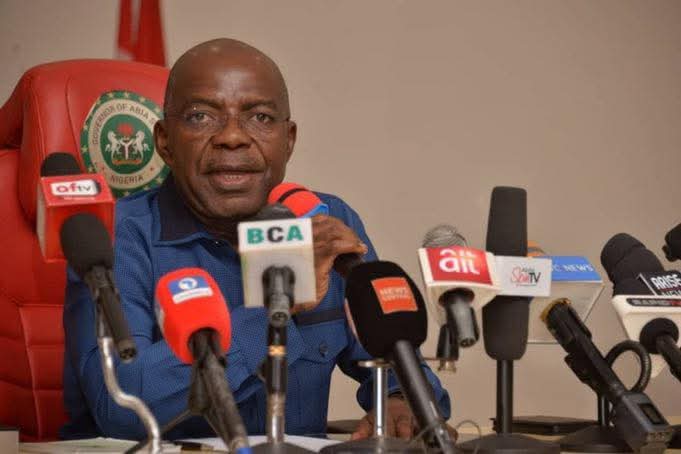

Insight into Otti’s call for national consciousness rebirth among Nigerians
By Ogbonnaya Ikokwu
The Harvard Business School Association of Nigeria’s 2025 Dinner in Lagos provided another opportunity for Gov. Alex Otti to continue his call for a change of mind about Nigeria’s leadership style and the attitude of the elite towards governance in the country.
The governor’s message, which was inspired by an experience in Boston 16 years ago, armed him to challenge Nigeria’s most privileged minds to confront a familiar paradox: “a country rich in individual brilliance but trapped in collective underperformance”.
The banquet hall in Onikan carried the refined calm, typical of Harvard alumni gatherings, with leaders in business, policy and technology, senior executives, entrepreneurs and professionals seated across gleaming tables.
The audience represented the caliber of people, who would likely choose to avoid the kind of dirty politics played in Nigeria, thus the governor’s lecture was delivered to the right audience – the Nigerian elite class!
The governor revealed that his speech, entitled, “Beyond Individual Success, Epiphany at Boston”, was inspired by a question he first encountered in 2009 during his Advanced Management Programme at Harvard Business School.
He said an American classmate of Indian descent, Samvit Raina, had asked him a simple but unsettling question: “Why is it that Nigerians I meet excel as individuals, yet the country they come from remains stuck in underdevelopment?”
Gov. Otti explained that the question was not a casual observation. “It was a mirror and forced a reflection on why a nation blessed with exceptional talent still struggles with basic structures of modern life: waste management, potable water, motorable roads, stable electricity, functional primary healthcare and quality basic education,” he said.
His conclusion was direct. “Nigeria’s best minds have abandoned the public arena, leaving the task of nation building in the hands of individuals, whose development orientation was, at best, questionable.
“While we were at Harvard, Oxford, MIT and Cambridge, achieving academic distinction, many of us saw government as a distant irritant. Meanwhile, people with limited education were taking decisions that shaped how the world viewed Nigeria,” he said.
Gov. Otti drew a sharp contrast between two sets of Nigerians he had encountered within 48 hours before the dinner in Lagos.
Earlier that week he had addressed thousands of young graduates in Federal University of Technology, Owerri and Ogbonnaya Onu Polytechnic Aba, many of them uncertain about the value of their certificates in a harsh economy. Standing now before members of Nigeria’s most successful one per cent, he offered a blunt assessment.
“To the world, to Boston, London and New York, we are all the same, a community of poor people. The success of a few outliers does not change the reality of the many,” Gov Otti insisted.
His message was simple and clear. Nigeria cannot change global perceptions until its elite class redefines success beyond personal achievement.
Tracing the path from that Boston moment to his entry into politics, Gov. Otti recalled the long and often brutal journey. Encouraged by a political elder to first rise to the top of the banking industry, he returned to the corporate world and became Group Managing Director of Diamond Bank. Still, the 2009 question continued to follow him.
By 2015 he left banking, contested the governorship and, after a disputed legal battle, lost. He lost again in 2019. Yet he persisted!
“We refused to be defeated, we rose again in 2023, determined to fight harder and more strategically,” he said.
That persistence eventually took him to the Government House in Umuahia in 2023. But he did not gloss over the darker aspects of that journey.
He spoke openly about assassination attempts, poison plots and the harsh reality that many well-meaning Nigerians, who ventured into politics paid heavily for it.
“This is not for the fainthearted, Even crime is not described as being for the fainthearted,” he said.
Reflecting on nearly three years in office, Gov. Otti described what he called the Abia Experiment. He listed achievements driven not by abundant resources but by deliberate governance choices.
According to him, the state rehabilitated more than 600 kilometers of roads, 40 per cent executed through direct labour by state engineers, saving billions of naira. He said that independent development researchers now rank Abia among states with the most improved road networks.
He also cited significant security gains, cleaner city environments, a revived civil service, and upgrades in health and education. Payments of long standing gratuity arrears, dating back to 2001 have commenced, with total obligations of more than 60 billion naira.
He further said that the state had also begun an enterprise support scheme for graduates of tertiary institutions, including recent disbursements of N150 million to polytechnic graduates.
Despite growing Internally Generated Revenue from about 20 billion to a projected 100 billion for 2025, Gov. Otti maintained that Abia is still far from being one of Nigeria’s wealthier states.
“Our success has not been because we have limitless funds but because every kobo is tied to our development objectives,” he said.
Gov. Otti credited part of the progress to lessons drawn from Harvard. These included recruiting for competence rather than connections, hiring world class professionals for strategic roles, and prioritising character as much as technical expertise. The goal, he said, was to build a government of technocrats committed to the principle of community above self.
In the closing section of his speech, Gov. Otti returned to the philosophical heart of his argument. He cautioned that no private success can stand firm in the midst of public decay.
“The best cars are useless without good roads. A functional health centre may save you before your mansion does. A great public school offers more long term return to society than any private jet,” he philosophised.
He echoed his Boston awakening with a warning thay “Individual success does not shield us from the shame of collective failure”.
Quoting Plato, he reminded the audience that those who avoid politics will eventually be ruled by their inferiors. Citing the playwright Bertolt Brecht, he noted that the political illiterate fails to understand that the cost of food, housing, medicine and even life itself depends on political decisions.
As the evening drew to a close, Gov. Otti left the room with a challenge rather than a celebration. Nigeria, he insisted, will only change when its best minds step into public service, shape policy and engage actively in the civic space.
One truth that still lingers in the air is that the real subject of the governor’s message was not Alex Otti. It was the mindset of Nigeria’s elite class.
Gov. Otti’s speech during the dinner
was not a triumphant speech. It was a call for a national conscience rebirth.
Successful Nigerians must change their mindset about politics and become interested in the quality of individuals, who occupy political offices.
#GovOttiIsBuildingTheNewAbia
To God Be The Glory
Ogbonnaya Ikokwu is a journalist and public affairs analyst writing from Umuahia.