
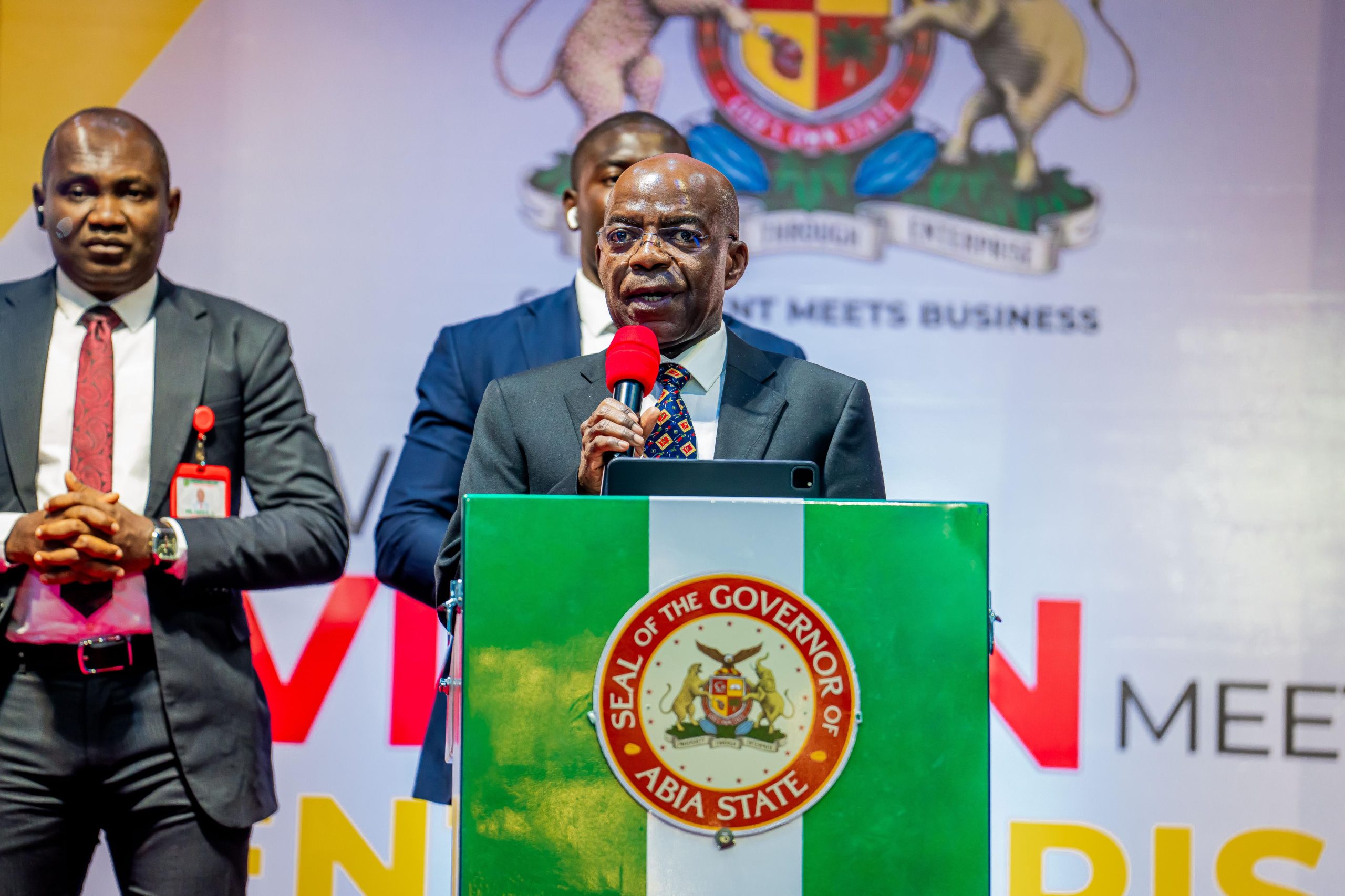

Where Government meets enterprise: Building new investment frontier in Abia
By Ogbonnaya Ikokwu
At a time when governments across the world are rethinking how best to drive economic growth, the debate over the proper role of the state in business remains as lively today as it was centuries ago.
In many countries, the question is no longer whether government should intervene in the economy, but how far it should go and where the private sector must lead.
It was against this backdrop that business leaders, policymakers and investors gathered in Umuahia early in the month for the Abia Business Roundtable, a forum designed to align public policy direction with private sector expectations.
The event concluded with a message from Gov. Alex Otti that echoed a growing global consensus: sustainable prosperity lies not in ideological rigidity but practical collaboration between government and enterprise.
Across the world, experience in economy offers compelling lessons. In the late 18th Century, Scottish philosopher, Adam Smith, argued that free markets, guided by what he called the invisible hand, could allocate resources efficiently, if governments allowed competition to flourish.
Nearly two centuries later, British economist, John Maynard Keynes, challenged that view, insisting that governments must sometimes intervene to stabilise economies and manage demand.
The gap between those ideas continues to shape economic policies. During the Great Depression of the 1930s, many governments expanded their role to stimulate struggling economies. The global financial crisis of 2008 again demonstrated that even the most market driven systems rely on public intervention to prevent systemic collapse.
Today’s largest economies reflect this hybrid reality. The United States, long associated with free market principles, still deploys largescale fiscal and regulatory tools during economic shocks. China, whose political system is rooted in state control, has encouraged vast private sector growth, while maintaining strong public oversight. In both cases, prosperity has emerged from a dynamic balance between state direction and private initiative.
For Abia State in South Eastern Nigeria, this global experience has become a guiding reference. Gov. Otti told participants at the roundtable that the State Government recognises the need for a measured but decisive role in shaping the economic environment.
His administration’s approach is built on a simple premise: government should not run businesses, but it must create the conditions that allow businesses to thrive.
In practical terms, this means investing heavily in infrastructure, strengthening institutions and ensuring law and order, while encouraging entrepreneurs to drive production and innovation.
“When the state builds the foundation for productivity, the private sector responds. “Investors look for signals that their capital will be protected and that markets will function,” a participant at the roundtable said during the panel session.
For many business owners in Abia, the most powerful signal has been the state’s aggressive infrastructure revolution. Roads, long neglected in commercial hubs, such as Aba and Umuahia, had become one of the most visible obstacles to economic activity. Poor transport networks slowed production, discouraged investors and forced some entrepreneurs to relocate to other states.
Rebuilding those links, therefore, became central to the government’s strategy. Over the past three years, the administration has committed more than 80 per cent of its annual budgets to capital projects, with a large share directed towards road rehabilitation in major commercial corridors.
The decision has come at a significant fiscal cost, but officials argue that the long term gains would outweigh the immediate sacrifices. Improved transport networks reconnect factories with markets, reduce logistics costs and restore confidence among manufacturers and traders.
For many in Aba, a city historically known for its entrepreneurial culture and manufacturing clusters, that confidence has long begun to return.
Economists often describe infrastructure as the backbone of private sector expansion. The World Bank estimates that inadequate infrastructure reduces economic growth in many African economies by as much as two percentage points annually. Reliable roads, power and security systems can, therefore, transform investment prospects in regions, where these essentials have long been absent.
Abia’s strategy has sought to address these constraints simultaneously. Alongside road construction, the government has introduced measures aimed at reducing the regulatory burdens that discourage small enterprises.
One of the earliest initiatives was a six month tax holiday for small businesses, designed to ease financial pressure on entrepreneurs recovering from years of economic stagnation. Officials say the measure was intended not only as relief but as a signal that the state was ready to rebuild trust with the business community.
Security improvements and institutional reforms have followed similar logic. By reducing uncertainty and strengthening enforcement, policymakers hope to create an environment, where investors can make long term plans.
The roundtable itself represented another layer of that effort. Rather than designing economic policies solely within government offices, the forum brought business leaders directly into the policy conversation.
Participants from manufacturing, finance, technology and agriculture sectors took part in break out sessions and panel discussions, sharing concerns about infrastructure gaps, regulatory barriers and investment opportunities.
According to the organisers, the insights gathered during those sessions will feed into future economic policies. The aim is to ensure that new initiatives reflect real business conditions rather than abstract assumptions.
Such collaboration between government and industry leaders has become a hallmark of successful economic transformations elsewhere. In Singapore, regular consultations between policymakers and corporate leaders helped shape the city state’s transition into a global trade and technology hub. In Rwanda, government-led reforms, combined with private investment, have rapidly improved the country’s business climate.
For Abia, the hope is that similar cooperation can unlock the potential of sectors that remain largely underdeveloped.
The state government has identified several areas as priority growth frontiers, including real estate, ICT, hospitality and solid minerals development. Manufacturing and agriculture are also expected to play central role, particularly in value addition industries that transform raw materials into export ready products.
Nigeria already possesses one of Africa’s largest consumer markets, and Abia’s commercial centres sit strategically within the country’s south eastern trade networks. Supporters of the new policy direction believe these advantages could attract both domestic and international investors, if infrastructure and governance continue to improve.
Yet, economic growth alone is not the administration’s ultimate objective. Officials emphasise that the deeper goal is inclusive prosperity.
Across Africa, one of the persistent criticisms of rapid economic expansion has been that its benefits often concentrate among a small segment of society. Abia’s strategy seeks to avoid that outcome by linking private sector growth with job creation and workforce development.
Over the past two years, the state government has sponsored skills training programmes for thousands of young people, preparing them for employment in emerging industries. The intention is to ensure that when new investments arrive, local workers possess the capabilities required by modern companies.
Equally important has been the government’s commitment to prompt payment of salaries and contractual obligations. Economists often describe this practice as increasing the “velocity of money,” meaning that cash circulates more rapidly through the economy as workers spend their earnings in local markets. That circulation can stimulate small businesses and raise household incomes, creating a cycle in which economic activity reinforces itself.
For investors evaluating potential locations, such indicators can matter as much as physical infrastructure. Predictable government policies, functioning institutions and a reliable consumer base often determine whether businesses choose one region over another.
By the close of the Abia Business Roundtable, the message from the State Government was clear: Abia intends to position itself as a competitive investment destination within Nigeria’s evolving economic landscape.
The administration’s invitation to investors was framed not as a short-term opportunity but as part of a long-term partnership. Government should continue to focus on infrastructure, human capital development and policy stability, while private enterprises drive innovation, production and employment.
Whether the strategy succeeds will depend on factors that extend beyond any single administration, including national economic conditions and global market trends. Yet, the underlying principle reflects a broader shift in economic thinking around the world.
Increasingly, prosperity is seen not as the product of either government control or unrestrained markets, but the outcome of an interplay between the two.
For Abia, the experiment has begun with a promise: that when public vision meets private enterprise, opportunity can expand into lasting prosperity.
#GovOttiIsBuildingTheNewAbia
To God Be The Glory
Ogbonnaya Ikokwu is a journalist and public affairs analyst writing from Umuahia.