

Service beyond ceremony: How merit-based appointments is redefining development in Abia
By Ogbonnaya Ikokwu
Governor Alex Otti has consistently shown that strong results in both the public and private sectors depend on placing qualified professionals in the right roles.
By appointing people on merit to ministries, agencies, and parastatals, his administration has brought fresh ideas into Abia State’s governance. This approach has delivered measurable progress and positioned Abia among Nigeria’s top-performing states in governance.
The Gov. Otti approach places core professionals strong institutions, systems, accountability and the ability of governments to outlive personalities beyond empty promises to deliver projects like
roads, bridges, airports, skyscrapers and headlines grabbing mega infrastructure.
This is because across some of the world’s most successful societies, the deeper engine of sustainable development has rarely been concrete and steel alone.
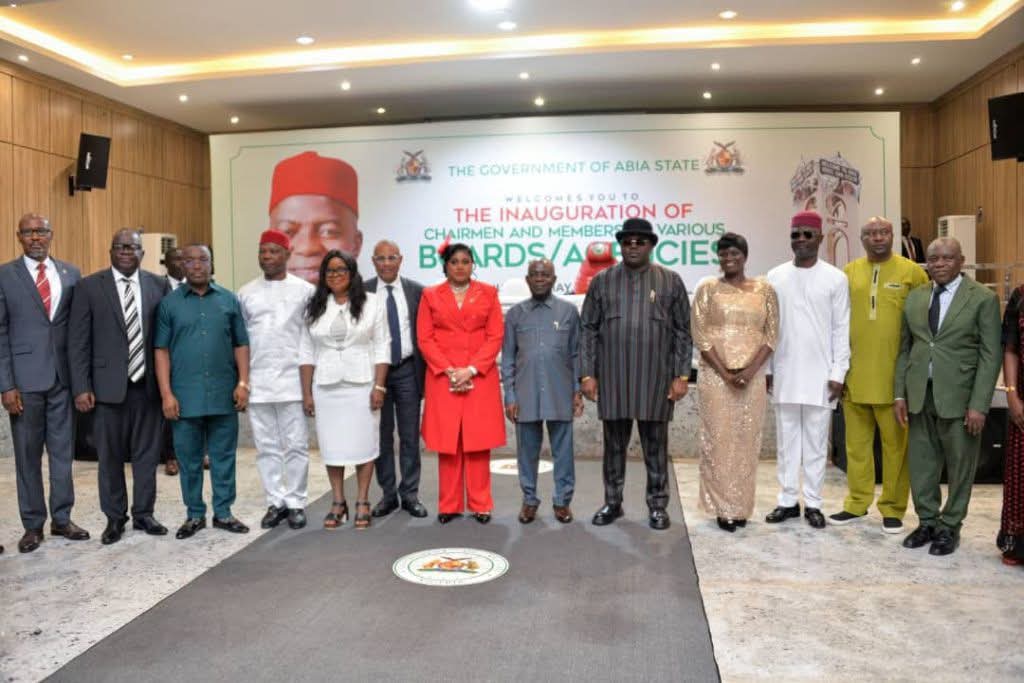
That philosophy formed the core of the address delivered by Gov. Otti during the inauguration of leadership and members of several strategic boards and parastatals at the Michael Okpara Auditorium, Umuahia, on Thursday.
Far beyond a ceremonial gathering, the event exposed a broader governance direction that increasingly mirrors global development models where strong institutions, public accountability and coordinated service delivery have become the true currency of progress.
Three years into the administration, the message from Government House was clear: governance, not politics, remains the administration’s defining priority.
Gov. Otti declared that although significant progress had been recorded, the administration had only achieved “a fraction” of its long term objectives. Yet, beneath the rhetoric was a deeper proposition, one that development scholars across the world consistently identify as the foundation of enduring state growth: restoring public confidence in governance.
From Rwanda to Singapore, from Estonia to the United Arab Emirates, modern governance success stories have followed a familiar pattern. Before economic miracles became visible, institutional discipline came first.
In Rwanda, reforms under President Paul Kagame rebuilt public institutions after the 1994 genocide, creating a governance structure that the World Bank later acknowledged for improving public service efficiency and accountability. Singapore’s transformation under Lee Kuan Yew similarly rested on disciplined institutions, anti corruption systems and strategic public sector management rather than natural resources alone.
What appears to be unfolding in Abia increasingly aligns with that global governance philosophy.
The Abia governor argued that the administration’s greatest achievement may not necessarily be physical infrastructure but “expanding the frontline of what is possible” and reviving public confidence in governance.
That statement reflects a growing global consensus that development is as psychological as it is structural.
According to the Organisation for Economic Co operation and Development, public trust in institutions directly affects investment, tax compliance, security cooperation and citizen participation in governance. Nations with stronger institutional trust records consistently outperform weaker states in economic resilience and social stability.
In practical terms, citizens begin to participate more actively in development when they believe government actions are predictable, transparent and aligned with public expectations.
That psychological shift appears central to the Abia administration’s messaging.
The governor described a State where citizens no longer accept failure in public service delivery as inevitable. He maintained that insecurity, infrastructural decay and institutional inefficiency should never again become normalised because the people have now “seen firsthand what can be achieved when the disposition of government is in sync with public expectations.”
This view represents more than political optimism. They indicate an attempt to recalibrate the relationship between the government and the governed.
The inauguration of the boards itself carried strategic significance.
The institutions inaugurated included the Governing Council of the Public Private Partnership and Investment Promotion Agency, Rural Access Roads Agency, State Roads Fund, Abia State Lottery Board, Abia State University Teaching Hospital Management Board and the Abia State Library Board.
Collectively, the agencies cover critical sectors including infrastructure financing, healthcare administration, education, investment promotion and institutional sustainability.
Globally, the use of specialised agencies and autonomous boards has become a tested governance model for improving efficiency and insulating critical sectors from excessive bureaucratic bottlenecks.
In the United Kingdom, the National Health Service relies heavily on independent trusts and management boards for operational oversight. In Canada, infrastructure agencies operate through institutional frameworks that separate policy supervision from operational execution. In Germany, regional development authorities function with significant administrative autonomy while remaining accountable to government policy objectives.
Experts argue that such governance arrangements often reduce political interference, strengthen oversight and improve continuity.
Gov. Otti appeared conscious of those institutional boundaries.
In one of the most significant portions of his address, he cautioned newly inaugurated board members against rivalry with management teams across ministries, departments and agencies.
He clearly defined the responsibility of boards as policy formulation, strategic guidance and institutional oversight, while leaving day to day management functions to administrative leadership.
Public administration analysts consider that distinction crucial.
Across many developing societies, conflicts between boards and management frequently weaken institutional effectiveness. Overlapping authority structures often produce internal rivalries, delayed decisions and governance paralysis.
The governor’s emphasis on cooperation, accountability and operational clarity therefore signals an effort to avoid governance duplication that has undermined public institutions elsewhere.
Equally notable was the administration’s emphasis on merit based appointments.
Governor Otti stated that all appointees were selected strictly on competence, professionalism and distinguished records in their respective fields.
That position touches on another defining debate in African governance. For decades, governance experts have linked underdevelopment across parts of the continent to weak institutional recruitment systems where political patronage frequently overrides competence.
The African Development Bank has repeatedly argued that sustainable growth in African states depends significantly on professionalising public institutions and strengthening merit based leadership recruitment.
Countries that successfully implemented such reforms have often recorded stronger governance outcomes.
Botswana, widely regarded as one of Africa’s best governed countries, built much of its post independence stability on merit driven civil service systems and institutional professionalism.
Similarly, Mauritius transformed itself into one of Africa’s strongest economies through consistent investment in institutional governance, public sector discipline and administrative continuity.
In Abia, the administration appears eager to project itself within that reformist framework. Another dimension of the governor’s address that drew attention was the welfare assurance extended to appointees.
He acknowledged the pressures public officials often face and assured that adequate provisions had been made to support their operational effectiveness and welfare.
Globally, governance researchers have long argued that institutional corruption often thrives where public officials operate under severe economic pressures without adequate support systems.
Singapore’s anti corruption model, for example, included competitive welfare structures for public officials alongside strict accountability systems.
While welfare alone does not eliminate corruption, experts note that functional institutional support systems reduce vulnerability to unethical practices.
The governor’s repeated emphasis on service over politics also reflects a broader leadership strategy increasingly gaining traction among reform minded administrations globally.
As election cycles approach in many democracies, governance often slows as political calculations dominate state activity.
However, governments that sustain development momentum during politically charged periods frequently strengthen public legitimacy.
In Ghana, for example, continuity in infrastructure and institutional reforms during election periods helped reinforce democratic confidence over the years. In Rwanda and the United Arab Emirates, long term policy consistency has similarly become central to governance credibility.
Gov. Otti’s declaration that “the best way to politick is to serve the people” therefore carries both political and governance implications.
Perhaps the most compelling aspect of the speech was its repeated focus on collective responsibility.
The governor praised the collaboration between the executive and legislative arms, arguing that the administration’s progress over the past three years was partly enabled by institutional harmony rather than inter governmental conflict.
Political historians note that many successful governance systems thrive not merely because of visionary leaders but because institutions cooperate toward shared developmental objectives.
The Scandinavian governance model, widely admired for efficiency and social trust, depends heavily on inter institutional cooperation, transparency and coordinated public sector accountability.
In Nigeria, where executive legislative conflicts have frequently slowed governance at different levels, the emphasis on institutional cooperation may prove increasingly significant.
Thursday’s inauguration in Umuahia was more than another government ceremony.
It reflected a broader governance conversation unfolding not only in Abia but across Africa, one that increasingly recognises that sustainable transformation depends less on slogans and more on systems.
As global development evidence repeatedly demonstrates, societies rise sustainably when institutions become stronger than individuals.
For Abia, that may well become the defining journey of this era.
#Gov. Otti is Building the new Abia!
#To God be glory!
Ogbonnaya Ikokwu, a journalist and public affairs analyst, writes from Umuahia