
Abia’s industrial ambition meets a changing world as Gov. Otti makes case for trade, investment and global prosperity

Abia’s industrial ambition meets a changing world as Gov. Otti makes case for trade, investment and global prosperity
By Ogbonnaya Ikokwu
The future of African economic development may depend less on how much assistance the continent receives and more on how effectively it converts its natural resources, human capital and entrepreneurial ingenuity into products capable of competing in international markets. It is a compelling economic argument, and one that Governor Alex Otti has placed at the centre of Abia State’s emerging investment proposition.
At a time when countries are reconsidering the geography of global manufacturing, strengthening domestic production and searching for more resilient supply chains, Gov.Otti believes Abia can occupy a strategic position in Africa’s next phase of industrial development.
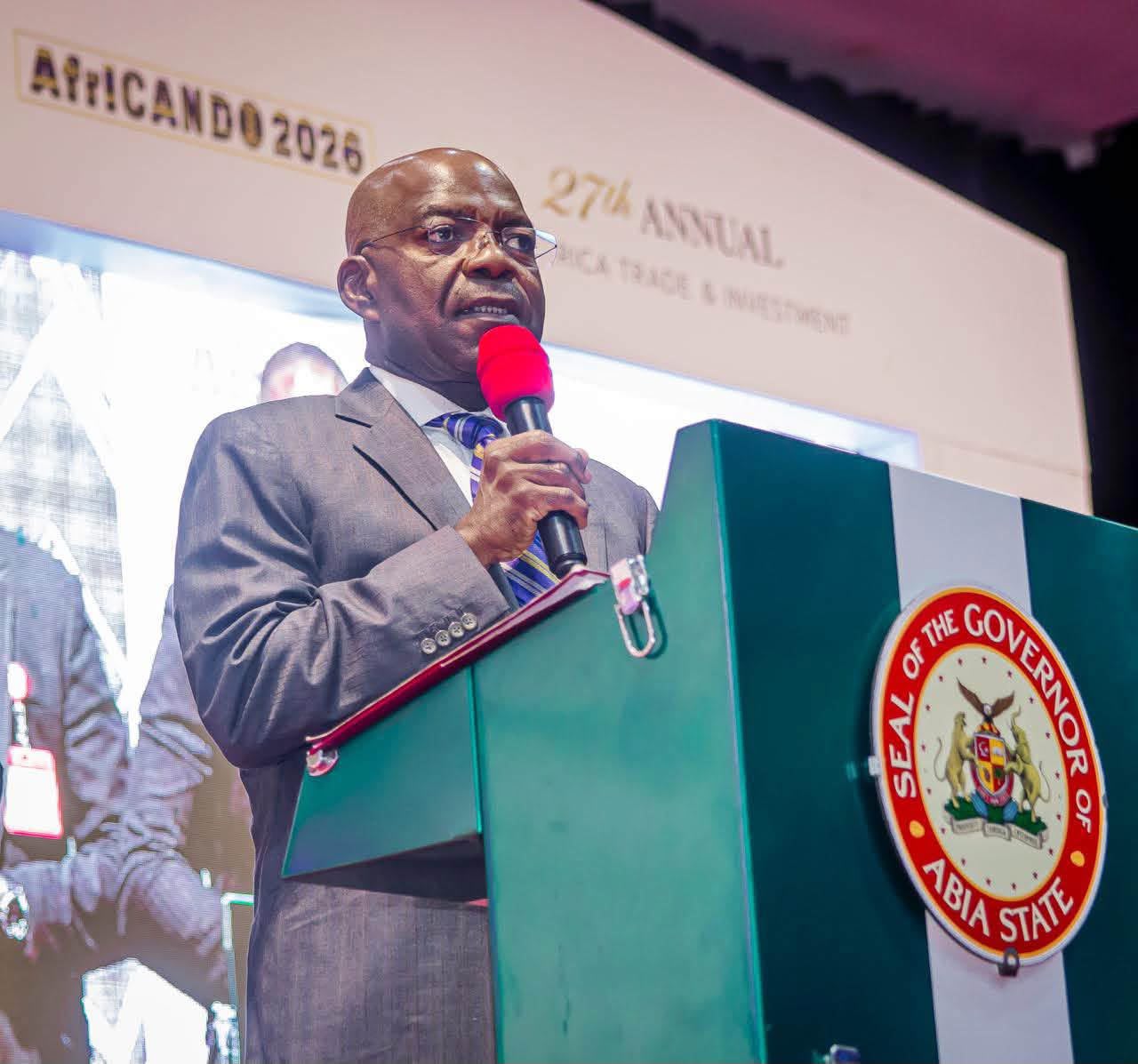
His message at the opening of the US Africa Trade and Investment Conference and Expo, AFRICANDO, at the International Conference Centre, Umuahia, on 17 November 2026, was therefore considerably bigger than an invitation to investors to visit Abia. It was a call for a fundamental change in the economic relationship between Africa and the developed world.
The governor challenged the longstanding development model that has relied heavily on foreign assistance, arguing that decades of aid have not delivered the structural transformation required to eliminate widespread poverty. Rather than dismissing humanitarian assistance, he questioned its ability to create sustainable prosperity when not accompanied by productive capacity, access to markets, technology transfer and investment.
His argument touches on one of the most consequential questions in contemporary development economics: why has a continent endowed with enormous mineral, agricultural and human resources continued to struggle with poverty, unemployment and limited industrial capacity?
For Gov. Otti, the answer lies partly in changing the terms of engagement. Africa must move from dependence to economic interdependence, with trade, investment and mutually beneficial partnerships replacing the expectation that development will principally arrive through charitable interventions.
The distinction is important. Foreign aid can provide emergency relief, support healthcare and education, and strengthen institutions.
However, productive investment creates businesses, jobs, markets and opportunities for wealth generation. Neither approach automatically guarantees development, but the latter can establish commercial relationships capable of sustaining economic activity long after individual assistance programmes have ended.
The international experience offers useful lessons. Vietnam, for instance, has demonstrated how sustained engagement with global markets can transform an economy. According to the World Bank, the country’s integration into international trade has been a major driver of its development over four decades, with approximately half of its gross domestic product and every second job directly or indirectly dependent on exports. Its next challenge is moving beyond assembly operations into higher value manufacturing, technology and stronger domestic supply chains.
That experience offers an important lesson for Abia. Producing goods is only the beginning; building industries that can consistently meet international standards, deliver competitive prices, maintain quality and fulfil large orders is what ultimately secures a place in global commerce.
The opportunity is particularly relevant following the latest extension of the African Growth and Opportunity Act. Originally enacted by the United States Congress in 2000, AGOA provides eligible sub-Saharan African countries with preferential duty free access to the American market for thousands of products. In September 2026, the United States extended the programme until December 2028, providing additional certainty for businesses and investors. However, eligibility requirements and the uneven utilisation of the programme mean that access must be matched by institutional compliance and export readiness.
Alongside AGOA is the African Continental Free Trade Area, which commenced trading on 1 January 2021. Its ambition is to create a single continental market, encourage regional value chains and make it easier for African businesses to trade across national boundaries. Yet the African Union’s vision will only become commercially meaningful when governments address inefficient border procedures, inconsistent standards, infrastructure deficiencies and other non-tariff barriers.
It is against this international background that Abia’s investment strategy deserves attention. Otti outlined an approach that places Abia at the centre of a wider economic development corridor, supported by road rehabilitation, improved security, urban renewal, power infrastructure and a 25 year development masterplan.
His administration’s establishment of the Greater Aba Development Authority is intended to coordinate the city’s development, while the Aba Export Growth Lab, developed with support from the United Nations Development Programme, is designed to prepare local enterprises for international markets. The initiative is particularly significant for the leather, footwear, garment, textile and agro-processing industries, where Aba already possesses an established entrepreneurial culture.
The governor also presented the Abia Industrial and Innovation Park in Ukwa West Local Government as a major opportunity for industrial investment. Its proposed development across approximately 2,000 hectares, supported by the area’s energy resources and strategic infrastructure, represents an attempt to attract large scale manufacturing and other commercial enterprises beyond the traditional Aba business corridor.
Beyond the industrial park, the governor highlighted road projects connecting agricultural communities across the state’s northern, central and southern districts. These include the 67.6 kilometre Umuahia to Ohafia corridor and the Ohanze to Akirikaobu road network. Such investments matter because industrialisation cannot thrive when farmers cannot efficiently transport raw materials, manufacturers struggle with logistics and finished products face expensive routes to market.
The scale of the challenge remains substantial. World Bank figures show that sub-Saharan Africa accounted for approximately 67 per cent of the world’s population living in extreme poverty in 2024, despite representing only 16 per cent of the global population. The statistics reinforce the urgency of creating productive economies rather than relying exclusively on poverty alleviation programmes.
Nevertheless, Abia’s ambition must ultimately be measured by outcomes rather than announcements, of which Otti is moving on a progressive path. Investors will want predictable policies, reliable electricity, accessible finance, efficient ports and transport connections, transparent land administration, skilled workers and consistent regulatory enforcement. Equally important will be the capacity of local businesses to meet international certification requirements and compete with established manufacturing centres.
Otti’s acknowledgement that Aba’s electricity supply remains dependent on consistent gas availability is particularly significant. It illustrates why infrastructure development must be sustained and supported by dependable energy arrangements. The proposed opportunities will require credible implementation, private sector confidence and long term institutional stability.
There is also a wider social dimension. The success of the investment drive should not be judged solely by the number of companies established or agreements signed, but by the employment opportunities created for young people, the expansion of small businesses, improved incomes for artisans and farmers, and the emergence of locally owned enterprises capable of competing internationally.
Ultimately, AFRICANDO presents Abia with an opportunity to translate its entrepreneurial heritage into a more ambitious economic future. The governor has made the invitation; the international community has been presented with the investment proposition. What follows must be a sustained demonstration that the state’s commercial possibilities can be converted into measurable returns.
For Africa, the message is equally consequential. Prosperity cannot be imported through perpetual assistance, nor can it be achieved by merely possessing abundant natural resources. It must be built through production, innovation, investment, competitive enterprise and access to markets.
In making Abia a meeting point for these conversations, Gov.Otti has placed the state within an important debate about Africa’s economic future. Whether that ambition becomes a defining industrial success story will depend on what investors, institutions, businesses and government collectively build after the conference lights go out.
And that is where the real business of prosperity begins.
#AlexOtti
#TheNewAbiaishere
#ToGodBeTheGlory
Ogbonnaya Ikokwu is a journalist and public affairs analyst writing from Umuahia.