
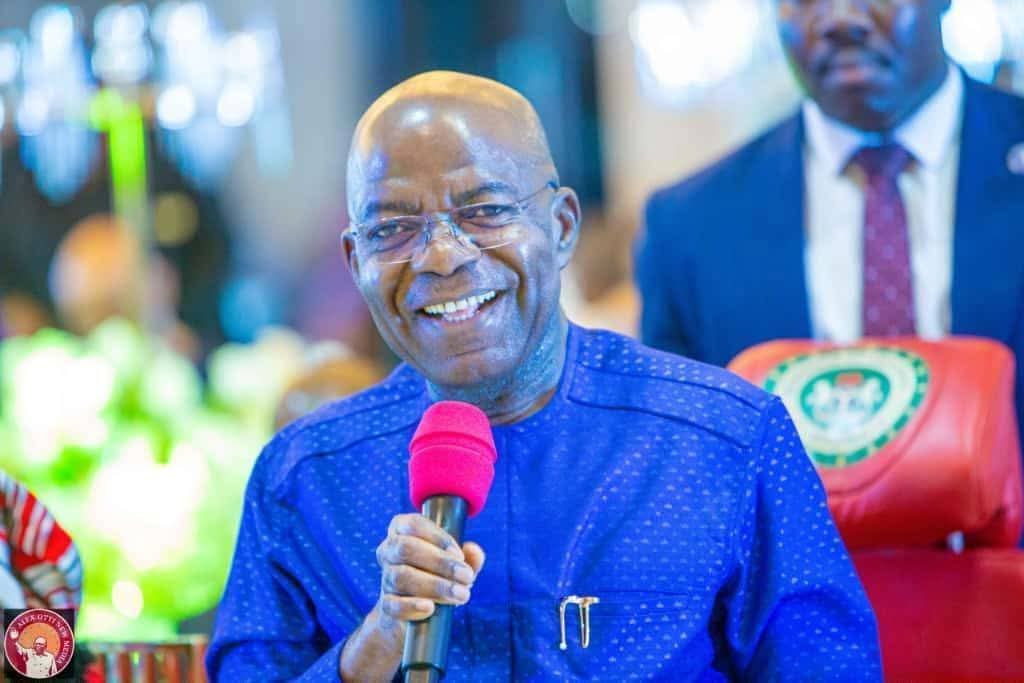

Governor Otti’s Leadership Footprints and the Reawakening of Ukwa-La-Ngwa
By Ebere Uzoukwa, PhD
For decades, Ukwa-La-Ngwa stood as a paradox within Abia State, rich in culture, commerce, and natural resources, yet weakened by political fragmentation, abandoned infrastructure, and missed opportunities. That narrative is now changing. Since 2023, the region has witnessed a quiet but profound reawakening driven by the governance philosophy and leadership footprints of Governor Alex Chioma Otti. What is unfolding across Ukwa-La-Ngwa is neither accidental nor cosmetic. It is the product of deliberate choices anchored on transparency, inclusion, and results-driven governance, steadily replacing stagnation with progress, discord with unity, and public cynicism with renewed confidence in leadership.
Before this administration, Ukwa-La-Ngwa reflected the consequences of weak governance. Despite its cultural vibrancy, commercial strength, and oil-producing status, the region was trapped in political disunity and developmental neglect. Infrastructure decayed, public trust eroded, and economic opportunities dwindled. Communities competed rather than collaborated, while successive governments failed to articulate or execute a coherent vision capable of uniting the people around shared prosperity.
Governor Otti’s emergence altered that trajectory. From the outset, his governance philosophy signaled a clear departure from the past. Transparency replaced arbitrariness, accountability supplanted impunity, and inclusion became the guiding principle of policy design and implementation. This shift was critical in healing old wounds, restoring trust, and rallying diverse interests behind a common developmental agenda.
Nowhere is this change more visible than in Aba, the commercial nerve centre of Ukwa-La-Ngwa. Once crippled by impassable roads, declining industry, and insecurity, the city has witnessed an infrastructural renaissance that has redefined its economic outlook. The reconstruction of major arteries such as Portarcourt Road, Aba-Owerri Road, Ohanku Road, and Omuma Road, alongside numerous inner-city roads, has restored mobility, lowered the cost of doing business, and reignited commercial activity. Aba has reclaimed its place as a hub of trade and enterprise, not through rhetoric but through concrete delivery.
Beyond roads, the restoration of stable power supply through the Aba Integrated Power Project has fundamentally transformed the business environment. For manufacturers, traders, and artisans, reliable electricity has translated into reduced production costs, increased productivity, and renewed competitiveness. Combined with targeted ease-of-doing-business reforms and support for small and medium enterprises, the administration has converted Aba’s long-acknowledged potential into tangible economic gains.
The impact of this governance approach extends beyond Aba to the wider Ukwa-La-Ngwa region. Industrial revival initiatives such as the acquisition and reactivation of Star Paper Mill and Agro Beverages, alongside the establishment of the Abia Industrial Innovation Park (AIIP), signal a strategic shift toward structured industrialization. These investments are designed not only to create jobs but to build long-term economic resilience anchored on value addition and innovation.
Equally significant is the deliberate attention paid to Ukwa’s oil-producing communities. For decades, these areas symbolized the paradox of resource wealth amid underdevelopment. Under Governor Otti, that narrative is changing. The repositioning of ASOPADEC to deliver impactful projects and the restoration of electricity through the Obehie high-tension infrastructure have brought tangible relief to communities long ignored. These interventions have reinforced the administration’s commitment to equity and inclusion, ensuring that development is not confined to urban centers alone.
Across the local government areas of Ukwa-La-Ngwa, investments in roads, healthcare, education, and agriculture have improved living standards and expanded opportunities. The revival of Ogbonnaya Onu Polytechnic in Aba, through salary clearance and infrastructure upgrades, further underscores the administration’s focus on human capital development as a pillar of sustainable progress.
Perhaps the most profound achievement of the Otti administration in Ukwa-La-Ngwa is the restoration of peace and unity. By prioritizing fairness, consultation, and results-driven governance, the government has reduced the incentives for division and rebuilt a sense of shared destiny. This explains the growing alignment of socio-cultural and civic groups such as Aba Nation under the leadership of Chief Barr. Theo Nkire with the administration’s vision, reflecting broad-based confidence in current leadership.
In less than three years, Governor Alex Chioma Otti has demonstrated that purposeful leadership can reverse decades of decline. Ukwa-La-Ngwa today stands at a new threshold, more united, more productive, and more hopeful. The transformation underway is not merely infrastructural or economic. It is psychological and social, marked by a renewed belief that governance can work for the people.
As the political horizon approaches 2027, the message from Ukwa-La-Ngwa is unmistakable. The progress achieved has elevated expectations and strengthened resolve. For a people who have experienced what focused, inclusive, and results-driven leadership can accomplish, continuity is not a slogan but a rational choice anchored in lived experience. Under Otti’s stewardship, Ukwa-La-Ngwa has rediscovered its promise, and the momentum of peace, development, and shared prosperity is firmly set to continue for generations.
Dr. Ebere Uzoukwa is a proud son of Ukwa-La-Ngwa and Senior Special Assistant to the Governor on Public Affairs.