
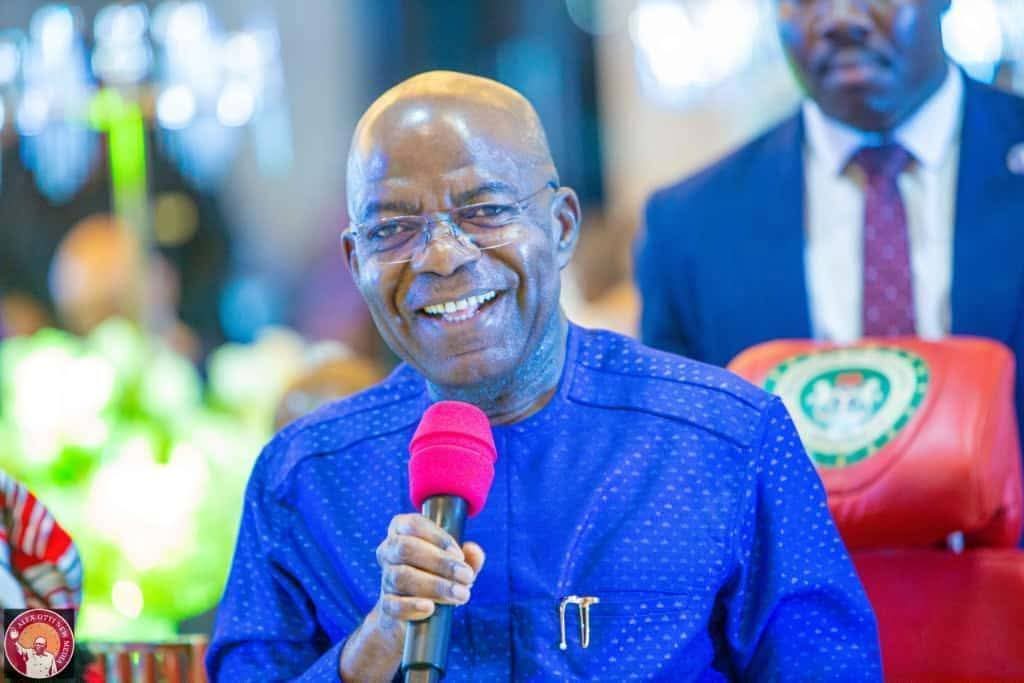

Otti unveils energy-led plan to reindustrialise South East and retain talent
By Ogbonnaya Ikokwu
Abia State Gov. Alex Otti recently outlined a strategy aimed at reshaping the economic fortunes of Nigeria’s South-East, with an emphasis on achieving reliable energy infrastructure which, according to him, is the cornerstone of industrial revival and job creation in the region.
He spoke at the South-East Vision 2050 Regional Stakeholders Forum (SEV2050) in Enugu, saying that decades of industrial decline in the region could be reversed through targeted energy investment and policy reform. He described the process as a quiet but transformative shift already under way.
Once associated with economic stagnation, the region is beginning to change shape, with Aba, the commercial nerve centre of Abia State, emerging as a model of public private collaboration in power provision.
The governor said the completion of Geometric Power Limited’s independent electricity ring had delivered stable and predictable supply, encouraging the return of entrepreneurs and reopening of dormant factories.
“Real estate activity has picked up, while small and medium sized enterprises are expanding, reflecting renewed investor confidence.
“The Aba corridor now enjoys more reliable electricity than most parts of Nigeria. This has catalysed job creation, revived industrial production and rebuilt private sector confidence,” he said.
Gov. Otti pointed out that Nigeria’s energy sector had long been hampered by inefficiency, underinvestment and weak governance, but said that recent federal reforms had begun to address the challenges. Chief among the reforms, he said, is the Electricity Act 2023, which liberalised the market and created space for State Governments and private investors.
Under the new framework, Abia State has acquired distribution assets from Interstate Electric and established the Abia State Electricity Regulatory Authority to oversee the local electricity market.
He outlined a three-pronged regional strategy – the first involves optimising resources through comprehensive mapping of conventional and renewable energy sources, including natural gas in Imo State, crude oil in Abia and Anambra, coal deposits in Enugu and Ebonyi, and the region’s solar, hydropower and biomass potential.
The second focuses on sustained infrastructure investment, with emphasis on building and upgrading generation, transmission and distribution networks. Government-led de-risking, Otti said, would be used to attract long term private capital, while ensuring regulatory stability.
The third pillar centres on market design, including fair pricing, transparent metering and a framework that balances investor returns with consumer affordability, conditions, he said, were essential for industrial scale energy deployment.
While acknowledging the importance of renewables in the long term, Gov. Otti argued that Africa’s development realities justify the continued use of coal and hydrocarbons in the near term. “Africa contributes less than five per cent of global emissions. “If coal is abundant here, it would be unreasonable to remain in darkness, while our industries and communities struggle,” the governor said.
He called for deeper regional collaboration, saying that industrialisation should not be pursued in isolation by individual states. A coordinated South East energy strategy, he said, could extend Aba’s experience across neighbouring states, avoid duplication of infrastructure and maximise available resources.
“We may not all run at the same pace, but we are better together,” Gov. Otti said, adding that expanding capacity at existing plants could serve the wider region more efficiently than building multiple new facilities from scratch.
For domestic and international investors, he said the South East offers significant opportunity, provided there is long term stability, regulatory clarity and market-ready infrastructure. Abia’s approach of initial state-led investment, followed by gradual private sector participation, he said, was designed to lower risk and build a commercially viable energy ecosystem.
It gladdens the heart to know that outcomes from the SEV2050 forum point to possible increase in collaboration among governments, businesses and development partners, positioning the South East as an energy driven industrial hub.
If fully harnessed and realised, the strategy could deliver between 10,000 and 15,000 megawatts over the next decade, create millions of jobs and gradually shift the region’s economic narrative from outward migration to local opportunities.
#GovOttiIsBuildingTheNewAbia
To God Be The Glory
Ogbonnaya Ikokwu is a journalist and public affairs analyst and writes from Umuahia.