
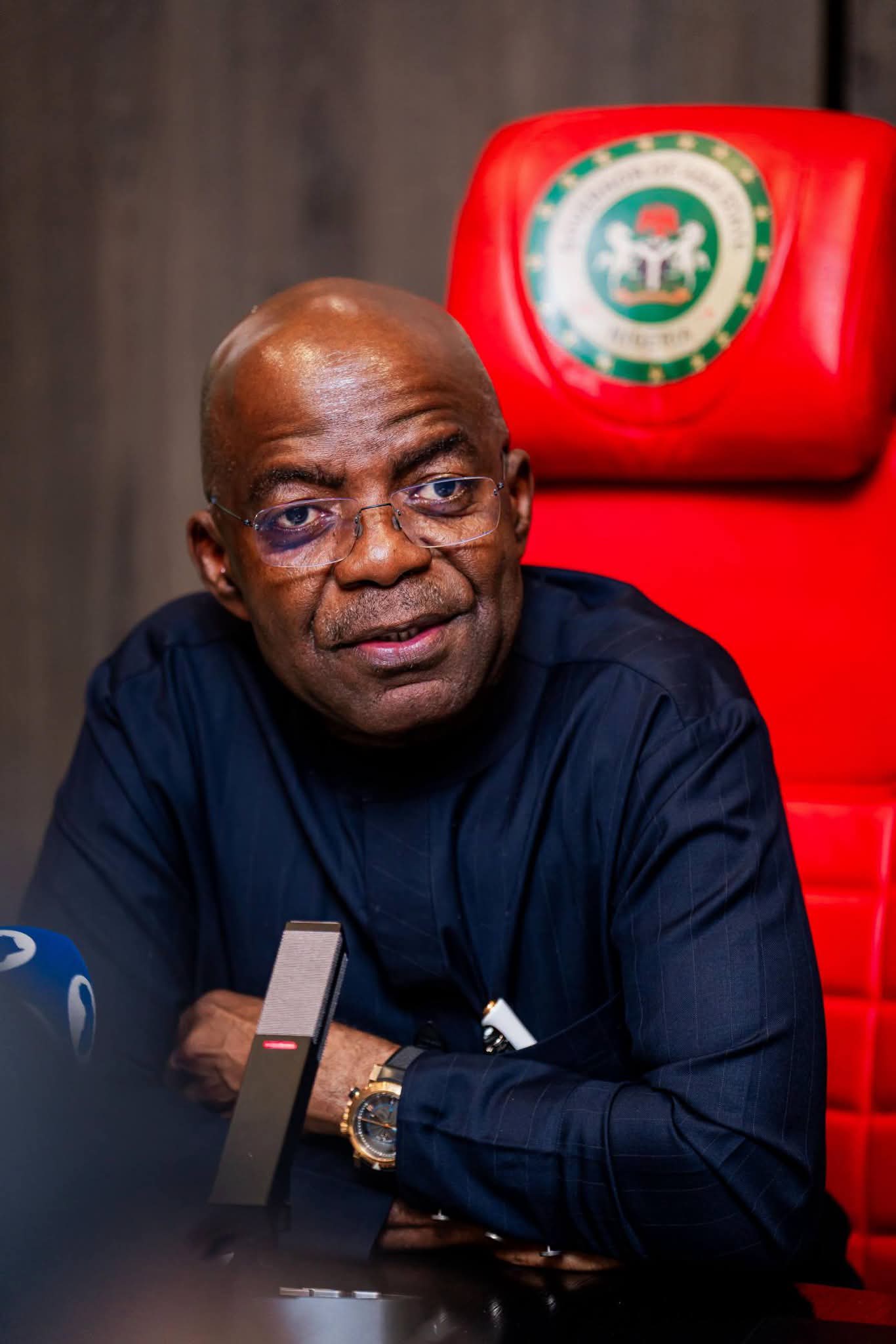

Celebrating Abia’s rise from grass to grace
– By Eagle Okoro
During the campaign for the 2023 Governorship Election in the state, one major characteristic about the candidate of Labour Party, Dr Alex Chioma Otti, that his apostles proudly bragged about is his integrity and capacity to deliver on the message of his campaign mantra that “a New Abia is possible”.
Indeed, no sooner was he inaugurated Abia’s fourth executive Governor than he commenced work in such a pragmatic and transformative manner that has today reshaped the landscape of the state. And, although the opposition considered his first major public assignment in Aba, precisely on May 30, 2023, where he was personally involved in scooping refuse from a heap of decomposed waste, as showmanship, the message demonstrated by the gesture of commitment to work still lingers.
Gladly, today, no corner of Aba, the state’s commercial nerve centre, and the capital city of Umuahia, wears the old filthy, scruffy looks.
So, without the fear of contradiction, Gov. Otti has achieved a remarkable feat on environmental sanitation, having drastically changed the narrative from Abia’s notorious reputation of a “stinking” state to earning public acclaim as one of the cleanest states in the federation.
Many Abians might have forgotten the scandalous comment by the Anambra-born multi-billionaire businessman, Chief Arthur Eze, in August 2014, when he was Special Guest of Honour to ex-Gov. Theodore Orji, during the celebration of the 23rd anniversary of the state’s creation.
Without paraphrasing, let’s rewind his exact remark that sent cold chill down the spines of Abia’s who’s who that filled the old Okpara Auditorium to the brim.
Picking up the microphone, a courageous Arthur Eze thundered: “Abia is stinking. Right from the Abia Tower in Umuahia, the rot hits you.
“Abia State is now the dirtiest in the country. Garbage everywhere, along with bad roads.
“The people are really suffering, and you see it in their faces. Are there no elders in Abia again? If so, what are they doing? “What are the senators, the members of House of Representatives and other elected people doing? Nothing.”
That was Arthur Eze’s no-holds-barred complimentary and goodwill remark to a government that was celebrating Abia’s anniversary in the midst of heaps of decomposed, stinky domestic waste that littered most neighborhoods in major cities of the old Abia.
Interestingly, Abia’s story of filth has positively changed and Gov. Otti has rewritten the narrative in the New Abia. Thus, thoroughfarers and visitors to Umuahia, nay Abia State in general, now have a breath of fresh air, with welcoming aroma and aesthetic aura that loudly and visibly define the New Abia, beginning from the Onuimo boundary with Imo State, through the Abia Tower and Aguiyi Ironsi Boulevard (formerly called Ossah Road) to Okpara Square.
Gov. Otti’s administration has also transformed the deplorable state of road infrastructure that characterised the entire length and breath of the major cities of Aba and Umuahia.
The complete collapse of roads in Aba brought commercial and industrial activities to a total halt. For instance, Port Harcourt Road, Aba, famous for the sales and repairs of heavy industrial machines and hospitality business, was completely closed to traffic. The road was taken over by overgrown shrubs and bushes that combined with heaps of refuse to make the federal road a blind alley, totally impassable for more than two decades.
Many other internal roads in the city suffered similar fate due largely to maladministration, ineptitude and insensitivity of previous administrations that superintended over the affairs of a “failed” Abia for 24 long years.
Interestingly, under the New Abia, the roughly 6.5km stretch of road had been restored. Industrial and commercial businesses have resumed and businessmen, who fled their business outfits and residences have returned, and the area that became desolate under the Peoples Democratic Party-controlled administrations have returned to life, and presently bubbling with human and social activities.
Remember the more than 70-year-old, ramshackle Omenuko Bridge, which existed as a major symbol of neglect by previous administrations in Abia, and the great transformation that took place on the bridge, alongside the long stretch of road linking some communities in Ohafia and Arochukwu LGAs, made possible by Otti’s administration.
Another area of interest that made God’s Own State notorious and a pariah in the comity of other states of the federation was the prevalence of violent crimes.
The concerning level of banditry and kidnapping for ransom on the Abia axis of the Enugu-Port Harcourt Expressway, particularly around the Lokpanta Cattle Market in Umunneochi Local Government Area, constituted a serious nightmare to motorists and commuters alike.
However, after weeks of futile appeals to the dare-devil gangsters to turn over a new leaf or relocate out of the Abia territory, Gov. Otti unleased a crack team of a combined security personnel, codenamed “Operation Crush” on the criminals. And as the name implies, the team, in a matter of weeks, crushed the bandits and kidnappers, and installed security and peace that have continued to endure in that part of Abia that was once a no-go area.
On the education sector, the administration has also recorded significant milestone, with massive reforms and structural transformation, with the comprehensive renovation and retrofitting of 227 schools, comprising 173 primary and 54 secondary schools, in the state.
In the dark days of Abia, most buildings and classroom blocks in public primary and secondary schools as well tertiary institutions were in decrepit and terrible state of dilapidation, completely unfit for teaching and learning. And while a good number of the structures had their roofs damaged, the classrooms were bereft of chairs and tables for the pupils and students. Those were the horrible conditions of the schools inherited from the old Abia. But, happily, the story has changed for the better in the New Abia.
Beyond the comprehensive renovation and retrofitting of structures in primary and secondary schools, the administration has also given a face lift to Abia State University, Uturu, together with the University Teaching Hospital, Aba, and College of Education (Technical), Arochukwu.
In addition, the administration has so far completed and inaugurated two smart schools, namely the Ogbo Central Smart School in Ipupe Ubakala, Umuahia South LGA, and the Umuomaiukwu Smart School in Isialangwa North LGA. This is pursuant to Gov. Otti’s agenda to build 20 smart schools in the 17 LGAs of the state.
On the health sector, the government also recorded remarkable success in the renovation and upgrade of the existing health facilities. It commenced the transformation of the health facilities with the renovation and retrofitting of Abia Specialist Hospital, Umuahia, Abia General Hospital, Amachara, and the Aba General Hospital.
With the impressive performance on the secondary and tertiary health facilities in the state, the government moved into the Primary Health Care (PHC), where it has renovated, retrofitted and functionalised about 121 PHCs across the LGAs through the “Project Ekwueme” initiative.
Joyfully, the measurable impact of Gov. Otti’s pragmatic and result-driven governance model in the past three years was handsomely rewarded in the 2026 Philips Consulting State Performance Index (pSPI), which rated Abia as the “third fastest-improving state in Nigeria”.
The deserving recognition truly reflects the transformative development agenda that the governor has diligently and passionately implemented across the different sectors and geopolitical sections of the state.
So, it took a mere three years plus of Gov. Otti’s administration to reverse the unsavoury public perception of notoriety held about Abia. The governor’s sterling record of multi-sectoral achievements is so commendable that Abians across the world now proudly identify with their home state, while showcasing the governor as the best thing that ever happened to the 35-year-old Southeastern state.
In a statement issued by the Commissioner for Information, Prince Okey Kanu, “the 2026 Momentum Index, which assessed the rate of progress made by 33 states during the review period, Abia recorded a positive momentum score of +0.67, placing it behind only Enugu State (+1.15) and Jigawa State (+0.77).”
The ranking placed God’s Own State ahead of Osun, Kano, Gombe, Akwa Ibom, Ogun, Lagos, Imo, Anambra and several other states of the federation.
According to Prince Kanu, the Momentum Index measures how far each state has advanced, relative to the national average, with positive scores indicating faster-than-average progress and negative scores reflecting slower rates of improvement.
He said: “Abia’s impressive performance demonstrates that the state’s ongoing reforms and development initiatives are yielding measurable and nationally recognised results.
“The latest ranking reinforces growing evidence that Abia is undergoing one of the most rapid transformations in the country, driven by strategic investments in critical sectors including infrastructure, education, healthcare, digital innovation, security, public sector reforms, agriculture, and economic development.
“From the reconstruction of major road networks and the establishment of Smart Schools across the state to reforms in governance, revenue administration, industrial revival, youth empowerment and investment promotion, the state’s development agenda continues to attract national attention and independent recognition.
“The ranking also reflects increasing confidence in Abia’s governance model, which places transparency, accountability, prudent resource management and people-centred policies at the heart of public service delivery.
“As the state continues on its trajectory of sustainable growth and economic renewal, the government remains committed to consolidating these gains, while accelerating development initiatives that improve the quality of life of every Abian.”
It is gratifying that the state has steadily and positively become one of the safest, most attractive investment destinations in the federation, with a meterioc and amazing transformation from repudiation and pariah status to a globally acceptable reputation, filth to fame, and grass to grace.
This uncommon achievement in one single tenure calls for retrospection and huge celebration. Citizens and residents should, therefore, roll out the drums to appreciate Abia’s rise to national and global reckoning.
Hence, as Gov. Otti’s first tenure gradually winds down, it is expected that the glory and glamour it brought to a state, once described as the least developed and most backward, East of the Niger, nay Nigeria, shall guide the people in making the right electoral choices in 2027, when they march to the polls to elect their leaders.
– Eagle Okoro, a Public Affairs analyst, writes from Umuahia