
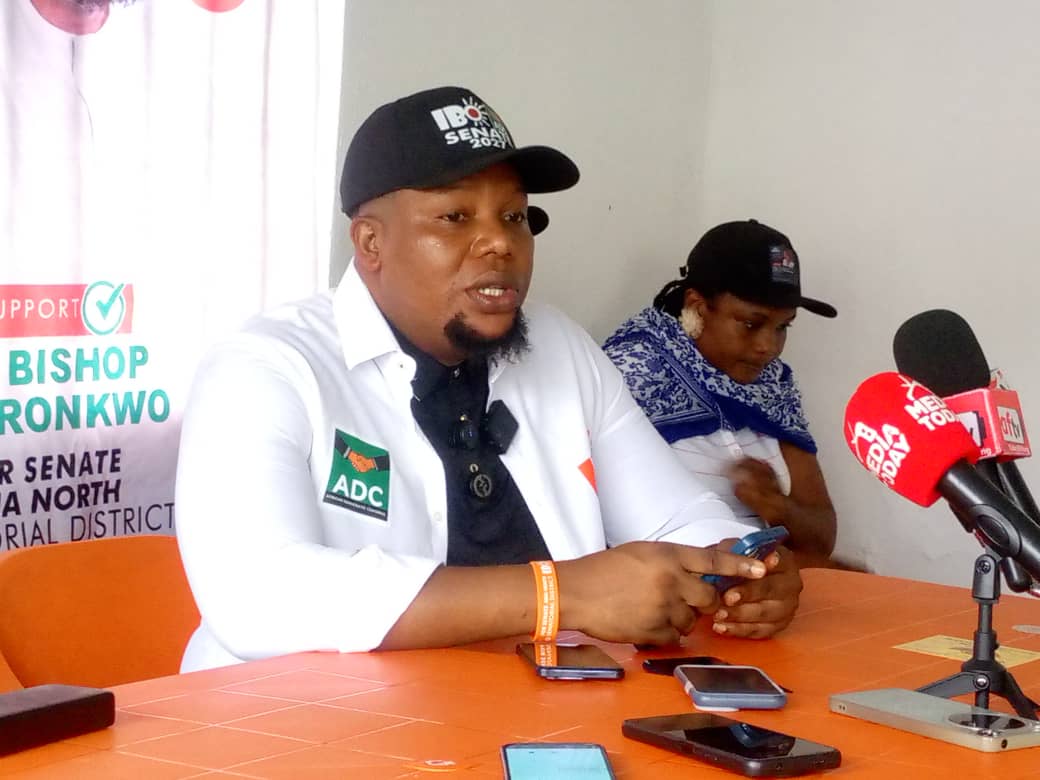
2027: Bishop Okoronkwo Unveils Campaign Organisation, Pledges Enterprise-Driven Representation for Abia North

2027: Bishop Okoronkwo Unveils Campaign Organisation, Pledges Enterprise-Driven Representation for Abia North
The African Democratic Congress (ADC) senatorial aspirant for Abia North, Ike Bishop Okoronkwo, has unveiled his Campaign Organisation, Campaign Council and Legislative Agenda ahead of the 2027 general elections.
Okoronkwo, who unveiled the organisation on Monday at the ADC Secretariat in Umuahia the Abia State capital, said the campaign is anchored on the theme: “O ZULA Zukwanu Ike! Enough is Enough – Let’s Take Back Abia North!”
Speaking at the event, Okoronkwo said his aspiration was driven by the need for measurable development and improved quality of life for the people of Abia North.
He said, “We are not merely unveiling a campaign organisation; we are declaring our readiness to pursue a new direction for Abia North.”
“We cannot continue to measure representation by political titles, years in office or promises made during election campaigns. We must measure it by the lives improved, the opportunities created and the development delivered,” he said.
Okoronkwo, who said he respects the office of the incumbent Senator, Orji Uzor Kalu, however called for performance-based assessment of representation.
He said the poverty challenges and infrastructure gaps in parts of the district demand a new approach that prioritizes enterprise, education and infrastructure.
Citing the 2022 National Bureau of Statistics Multidimensional Poverty Index which estimated multidimensional poverty in Abia North at 28.8 percent, Okoronkwo said political leadership must be judged by the quality of life of the people.
He further alleged that issues such as erosion, poor roads in Umunneochi and other communities, and youth unemployment remain pressing concerns for constituents.
The ADC aspirant outlined a four-point legislative agenda which includes Education, Prosperity, Agriculture and Women’s Inclusion, and Infrastructure.
On education, he said he would pursue legislative interventions to expand scholarships, technical and vocational education, digital skills and apprenticeship opportunities.
He said, “Education must become a practical pathway out of poverty.”
On prosperity, Okoronkwo proposed an enterprise programme tagged ABIA NORTH ARISE: Agribusiness, Resilient Enterprises, Innovation and Sustainable Employment, aimed at supporting entrepreneurs, artisans, traders and small businesses through grants, training, mentoring and market access.
He said, “Our people do not need empowerment that begins and ends with distribution of money during election seasons. They need sustainable opportunities.”
He pledged to dedicate 80 percent of his eligible personal Senate earnings to the empowerment mission, with a target of supporting 5,000 people into enterprise and mobilising 10,000 job and livelihood opportunities in four years, subject to applicable laws.
On agriculture, Okoronkwo said he would pursue legislative and budgetary interventions to support farmers and women-led businesses, adding that his team has commenced conversations with development partners to explore agricultural and enterprise investments.
He said, “Abia North has enormous agricultural potential, but our farmers need improved access to finance, modern farming techniques and reliable markets.”
On infrastructure, he promised to lobby for federal budgetary allocations and advocate for rehabilitation of priority roads across Ohafia, Abam, Isuikwuato and Acha, and improved power access for rural communities.
He said, “A senator does not personally execute every road or electricity project. However, a committed senator can use legislation, appropriation, advocacy and oversight to push projects forward.”
Okoronkwo said his campaign would focus on issues and measurable targets rather than personal attacks.
According to him, “I am not seeking election into the Senate simply because I believe it is my turn. I am seeking the mandate because I believe we can do better.”
“The time has come to change the conversation, change the priorities and change the outcomes,” he added.