
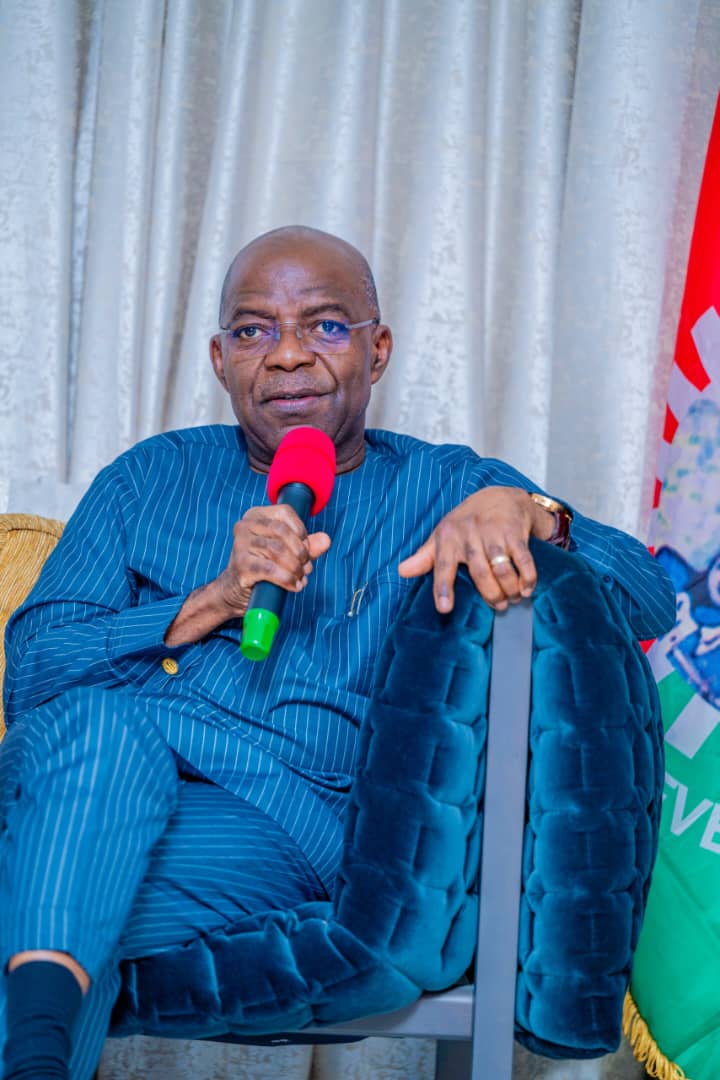

Alex Otti’s Education Revolution and the Promise of a New Abia
By-Charles Chinekezi
In public governance, there are moments when leadership merely administers existing structures, and there are moments when leadership fundamentally alters the trajectory of society. Since assuming office on May 29, 2023, Abia State Governor Alex Otti appears determined to belong to the latter category.
Within less than three years, the Labour Party administration has placed education at the center of governance in a manner rarely witnessed in recent Nigerian subnational politics. What is unfolding in Abia State today is more than routine policy implementation; it is an intentional effort to rebuild a society beginning from its classrooms.
For decades, Abia’s education system—once admired across Nigeria’s South-East—gradually slipped into decline. Dilapidated infrastructure, unpaid teachers, falling academic standards, and declining enrollment weakened public confidence. Parents increasingly abandoned government schools, while students bore the long-term consequences of systemic neglect. Education, which should have been the great equalizer, became another casualty of governance failure.
Governor Otti inherited this reality. The significance of his reforms, therefore, must be understood not simply as administrative actions but as corrective historical interventions.
Perhaps the most transformative decision of the administration was the declaration of free and compulsory education at the primary and junior secondary levels. In a country where millions of children remain out of school due to economic hardship, this policy represents a powerful social statement: that access to education is a right, not a privilege reserved for those who can afford it.
The immediate implication goes beyond increased enrollment. Free education restores hope to low-income families and interrupts the cycle of poverty that often begins when children are denied learning opportunities. It signals that government recognizes education as the foundation of economic mobility and social justice.
However, free education without functional schools would amount to symbolism. The Otti administration appears to understand this reality. Across Abia State, rehabilitation projects targeting public school infrastructure have begun reversing years of abandonment. Renovated classrooms, improved sanitation facilities, and modern learning spaces are gradually redefining the physical experience of public education.
Infrastructure matters because environment influences learning psychology. A child who studies in a clean, well-equipped classroom learns not only mathematics or language but also dignity and self-worth. By rebuilding schools, the government is rebuilding confidence—both institutional and societal.
Yet buildings alone do not educate students; teachers do. One of the administration’s most commendable decisions has been its focus on restoring professionalism within the teaching workforce. Verification exercises aimed at eliminating ghost workers may not attract headlines, but they are essential reforms. They restore fiscal discipline and ensure that public funds reach real educators performing real work.
Equally important has been the recruitment and deployment of qualified teachers, especially to rural communities historically deprived of educational resources. This approach reflects an understanding that educational inequality often mirrors geographical inequality. When rural schools receive competent teachers, educational justice becomes achievable.
Teacher welfare has also emerged as a defining feature of the administration’s education agenda. Prompt payment of salaries and settlement of arrears have revived morale among educators who previously struggled under financial uncertainty. A motivated teacher is perhaps the most powerful educational investment any government can make. When teachers feel respected, classrooms become spaces of inspiration rather than obligation.
Another dimension of the reforms deserving recognition is the administration’s forward-looking embrace of technology and digital learning. In an era defined by artificial intelligence, digital economies, and global competition, education systems that remain analogue risk condemning their students to irrelevance. By promoting ICT integration and STEM education, the government is positioning Abia’s young population for participation in the knowledge economy.
This technological orientation demonstrates strategic thinking. Economic prosperity in the twenty-first century will depend less on natural resources and more on human intelligence, innovation, and adaptability. States that invest early in digital education are essentially investing in future competitiveness.
Beyond policies and projects lies an equally critical objective: the restoration of academic standards. Strengthened inspection mechanisms, structured supervision, and renewed emphasis on discipline signal a departure from the era when academic outcomes were secondary considerations. Education reform must ultimately be measured not by announcements but by learning results, and the administration appears to be steering the system toward measurable excellence.
The provision of instructional materials further reinforces this commitment. Textbooks, teaching aids, and learning resources may appear routine, yet they are often absent in struggling education systems. Their availability transforms teaching from theoretical instruction into practical engagement, improving comprehension and intellectual development.
Perhaps the most telling indicator of success so far is the gradual return of public trust in government schools. For years, public education in many parts of Nigeria suffered reputational damage severe enough to drive even low-income families toward private alternatives. When parents begin reconsidering public schools, it signals a deeper institutional recovery—one rooted in credibility.
Education reform, however, is not an isolated sectoral achievement. It represents the philosophical core of what the administration describes as the “New Abia” vision. By prioritizing human capital development, Governor Otti is advancing a governance model that sees education as the engine of economic transformation, youth empowerment, and social stability.
History offers compelling lessons. Societies that achieved rapid development—from post-war Asia to modern European economies—did so by investing heavily in education before economic miracles became visible. Industrial growth, technological advancement, and entrepreneurial expansion typically follow educational revitalization.
Abia State now appears to be attempting a similar pathway at the subnational level.
Of course, challenges remain. Educational reform is inherently long-term; its true results may not fully emerge for a decade or more. Sustaining infrastructure maintenance, expanding digital access, ensuring continuous teacher training, and preserving policy consistency beyond political cycles will determine whether current gains mature into lasting transformation.
Nevertheless, leadership must be evaluated by direction as much as by destination. The direction of Abia’s education sector today suggests intentional progress rather than accidental improvement.
Critics may argue that reforms are still unfolding and that broader socioeconomic pressures continue to affect educational outcomes. Such skepticism is healthy in a democracy. Yet even critics increasingly acknowledge that education has returned to the forefront of governance discussions in Abia State—a development that itself marks significant progress.
Ultimately, the true beneficiaries of these reforms are not politicians or institutions but children—young Abians whose futures depend on the quality of opportunities available today. Every renovated classroom, every paid teacher, every new learning resource represents an investment in human potential.
Governor Alex Otti’s education initiatives may therefore come to define his legacy. If sustained, they could restore Abia’s historical reputation as a center of academic excellence and intellectual productivity within Nigeria’s South-East and beyond.
In governance, the most enduring monuments are not roads or buildings but educated citizens capable of shaping their own destinies. By choosing to rebuild Abia through education, the administration is betting on the transformative power of knowledge.
Time will ultimately judge the success of this experiment. For now, however, one conclusion appears increasingly difficult to dispute: Abia State is rediscovering the idea that the future begins in the classroom.