
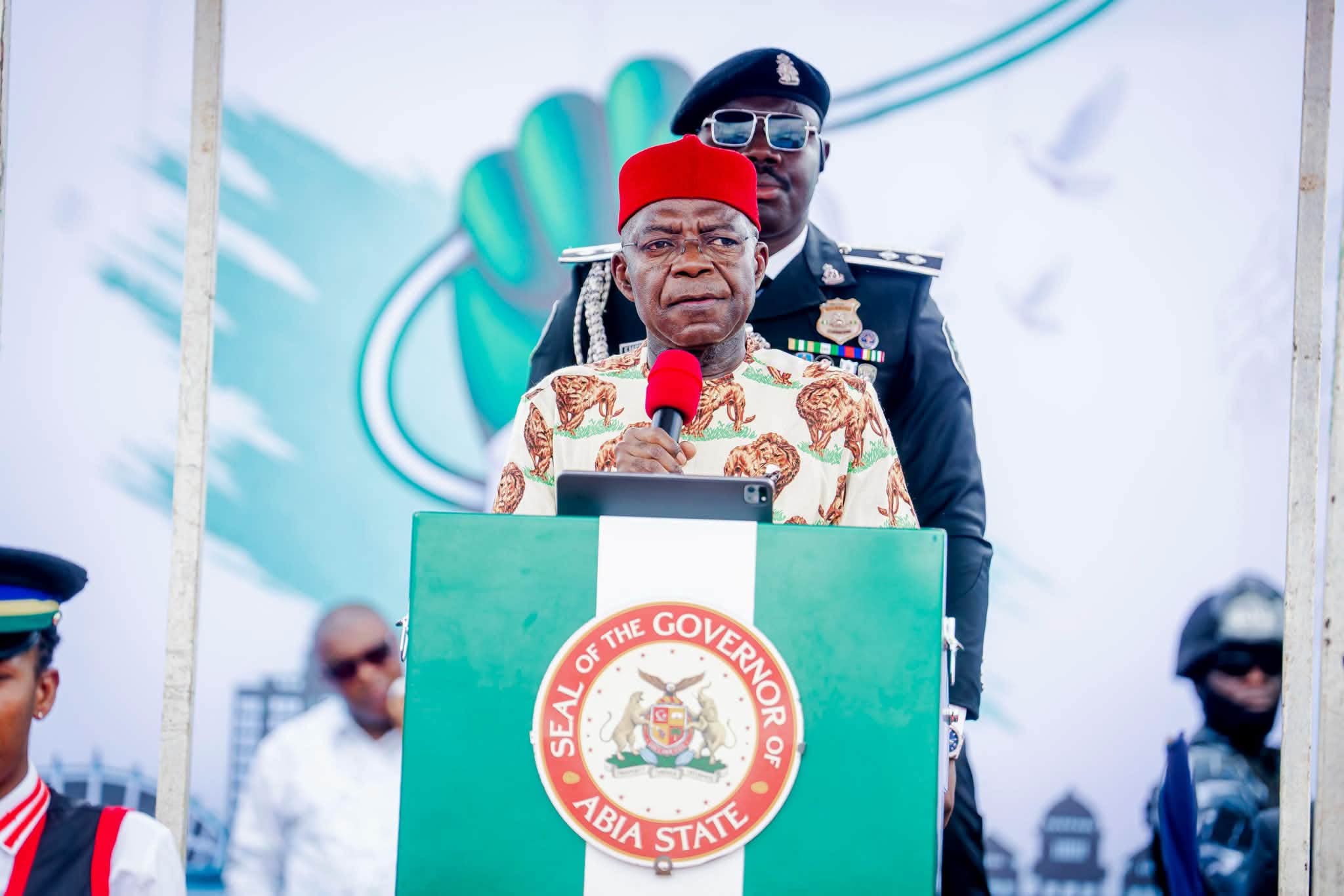

Beyond October 1960: Gov. Otti’s Independence Charge to Convert Freedom Into Institutional Value
When Governor Alex Otti spoke of citizenship, freedom and vigilance on Nigeria’s 66th Independence anniversary, the most striking feature of his message was not nostalgia for 1960 but a challenge to convert freedom into functioning institutions, productive work and measurable public value.
That emphasis gives the Abia governor’s address a contemporary relevance. Nigeria entered independence with enormous expectations, yet six decades later the World Bank says the country still faces widespread poverty, infrastructure gaps, insecurity, weak job creation and the pressure of absorbing about 3.5 million new labour force entrants annually.
Its 2026 assessment also records stronger macroeconomic performance, while warning that growth remains insufficient to create enough productive jobs or substantially reduce poverty. The contradiction between national potential and everyday outcomes is therefore not merely political rhetoric; it is a development problem documented by international evidence.
Gov. Otti’s intervention is significant because he locates part of the answer in citizenship itself. His argument is that government cannot carry the entire burden of national renewal when citizens withdraw from public responsibility.
Voting, paying taxes, obeying rules, rejecting corruption, working diligently and participating in civic conversations may appear ordinary, but together they form the social infrastructure on which effective institutions depend.
That proposition has parallels beyond Nigeria. Singapore’s development experience is frequently associated with strong institutions, public administration and compliance with civic rules, while Rwanda’s post-genocide reconstruction has placed substantial emphasis on institutional capacity, public order and citizen participation.
The circumstances of those societies are different from Nigeria’s, and their models cannot simply be transplanted. Yet the broader lesson is familiar across successful development experiences: infrastructure and economic reforms become more durable when institutions command public confidence and citizens participate in sustaining them.
It is against that wider backdrop that Otti’s description of Abia’s transformation becomes central to the Independence Day narrative. Since taking office in 2023, his administration has presented infrastructure, education, healthcare, transport, security, agriculture and civil-service reform as interconnected parts of a development strategy. The state government reports that 13 road projects were commissioned in May 2026, while the Umuahia Central Bus Terminal, with stated capacity for more than 340 buses, was also commissioned. It has also announced the rehabilitation of the Ubakala and Ariaria water schemes and the reconstruction of Okpuala Ngwa General Hospital.
Education occupies another prominent place in the administration’s stated priorities. Gov. Otti said in March that Abia had committed 20 per cent of its annual budget to education for three consecutive years. The figure, if sustained through implementation, places human capital alongside physical infrastructure rather than treating education as a secondary expenditure.
The governor’s development argument is also visible in the state’s investment narrative. The Abia government says its development plan to 2050 is designed around infrastructure, education and healthcare, while its 2026 manpower-development allocation is put at N5 billion. It also reports efforts to improve the business environment and attract investment, including engagement with federal economic agencies and private-sector interests.
None of these measures by themselves settles the national question Gov. Otti raised. Development outcomes require sustained implementation, transparent institutions, accountable leadership and citizen participation. But that is precisely the point at the heart of his Independence Day message: freedom is not a finished product delivered on October 1, 1960; it is a responsibility renewed by every generation.
For Abia, the message acquires a practical dimension. A state seeking to modernise roads, transport, education, healthcare, water systems and the business environment must also cultivate citizens prepared to protect public assets, comply with lawful rules, demand accountability and contribute productively.
Gov Otti’s final appeal, therefore, reaches beyond ceremony. His Independence Day broadcast presents vigilance as the bridge between political freedom and developmental freedom: the freedom to live securely, learn, work, trade, innovate and build a future at home. In that framing, the enduring test of independence is not whether Nigerians inherited the right to govern themselves, but whether each generation can build institutions and habits worthy of that inheritance. That is the real test today.
#GovernorOttiIsBuildingTheNewAbia
#ToGodBeTheGlory
Ogbonnaya Ikokwu is a journalist and public affairs analyst writing from Umuahia.