

Gov. Otti puts continuity, institutional reforms at heart of Abia’s 2027 governorship race
By Ogbonnaya Ikokwu
As New Abia moves from rescue to consolidation, Governor Alex Otti presents a development record, global competitiveness and the future of Abia as the defining issues in re-election bid
The question of how governments can transform struggling economies, rebuild public institutions and translate infrastructure investments into improved living standards has become one of the defining development conversations across emerging economies.
In Abia State, Gov. Otti is making that question central to the political contest ahead of the 2027 governorship election, presenting the next four years as an opportunity to consolidate what his administration describes as an ongoing transformation of the state.
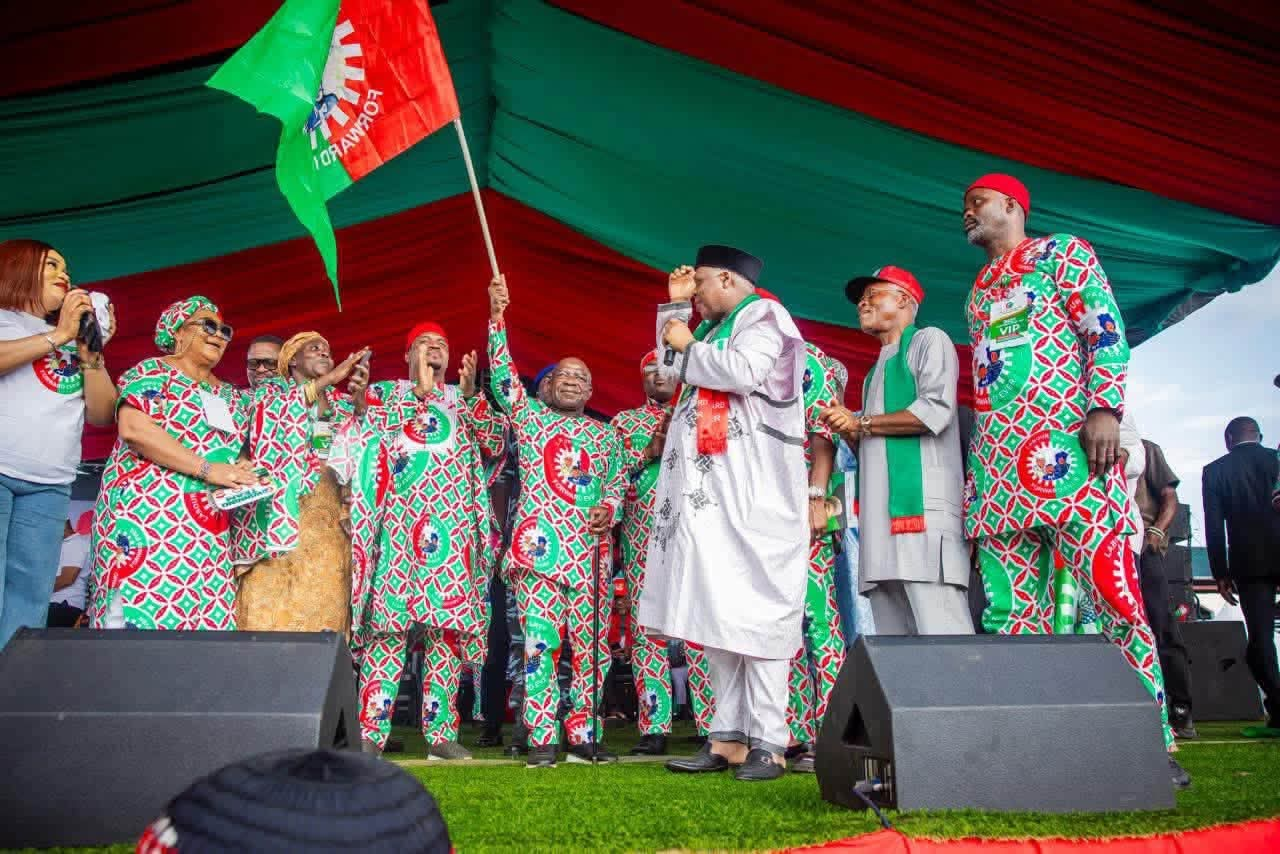
At the Umuahia Township Stadium on Sunday, November 1, 2026, where the Labour Party formally flagged off its governorship campaign, Gov. Otti offered more than a conventional re-election appeal. He presented a political and development argument built around continuity, institutional discipline, economic repositioning and the need to sustain reforms beyond the initial phase of governance.
Under the banner, Winning Together, the governor, who is seeking another four-year mandate alongside his deputy, Engr. Ikechukwu Emetu, invited Abians to consider the 2027 election not merely as a contest between political parties but as a decision about the direction and sustainability of the state’s development trajectory.
His central proposition was straightforward: having moved from what he described as an era of institutional failure and governance disappointment to a period of reconstruction and renewed public confidence, Abia should now concentrate on consolidating its gains, strengthening public institutions and preparing its economy for emerging opportunities.
It was an argument that placed the future of the state above the immediate excitement of a political campaign. For Gov. Otti, the journey to this moment began long before his inauguration on May 29, 2023. Recalling the political struggle that preceded his emergence, he traced the movement’s origins to 12 years earlier, when he and his supporters began advocating a different approach to public administration.
He described the movement as a response to the frustration of citizens who, in his assessment, had experienced years of inadequate infrastructure, institutional weaknesses and limited opportunities.
What initially began as a political aspiration, he recalled, developed into a broad-based movement that reached markets, community squares, religious centres and neighbourhoods across Abia and beyond.
The significance of that history, as presented in his address, was not simply electoral. It was the emergence of a political constituency united by the expectation that public office should translate into measurable improvements in people’s lives.
That expectation now provides the foundation of his re-election argument.
Gov. Otti also used the occasion to acknowledge the contributions of supporters and political associates who participated in the struggle but did not live to witness the present stage of the movement. He remembered Prince Otisi Ndukwe Kalu, popularly known as Abbot, Mazi Nnanna Ngwu, Mr Eze Alomefuna, Prince Dike, Dr Mike Nwachukwu, Prince Emeka Obasi, Chief Enyi Aji and Chief Mike Nkwoji, among others.
The tribute added an emotional dimension to the campaign, reminding supporters that political movements are sustained not only by those who occupy public office but also by individuals whose commitment, sacrifices and contributions help shape their direction.
Yet, beyond the symbolism of political history and remembrance, the more consequential part of the governor’s address was his attempt to connect Abia’s development experience with the broader principles guiding successful economies around the world.
Across developing countries, infrastructure has increasingly been recognised as a foundation for economic competitiveness.
The World Bank’s development analysis identifies efficient transportation as a means of connecting workers to employment, businesses to markets and communities to essential services. Its 2026 transport development publication highlights investments in transport networks in countries including Senegal, Brazil and Kazakhstan as instruments for improving mobility, expanding economic opportunities and generating employment.
The lesson is relevant to Abia, where Aba’s commercial activities, Umuahia’s administrative importance and the economic potential of rural communities depend significantly on reliable transportation networks.
This explains why road infrastructure occupied such a prominent place in Otti’s presentation. According to figures presented by the governor during the campaign flag-off, his administration has completed more than 400 road projects covering over 1,000 kilometres, while another 82 projects spanning more than 200 kilometres are ongoing.
He identified several projects as examples of the administration’s intervention, including Port Harcourt Road, Obohia Road and Ohanku Road in Aba, the Ozu Abam-Arochukwu Road, Omenuko Bridge, the 67.4-kilometre Umuahia-Uzuakoli-Akara-Abiriba-Ohafia Road and the expansion of Aguiyi Ironsi Boulevard in Umuahia.
The political and economic significance of such investments lies in their potential to reduce transportation difficulties, improve access to commercial centres, facilitate the movement of agricultural produce and lower the cost of doing business.
Earlier, at his May 2026 third-anniversary briefing, the governor had reported that 414 road projects covering 864.12 kilometres had been completed, with another 82 projects measuring approximately 212 kilometres under construction. The figures provide an independently published record of the administration’s earlier infrastructure account, while the campaign address presents its updated position.
For communities that have endured years of difficult access to markets, schools, healthcare facilities and other essential services, the ultimate measure of these projects will be their durability, accessibility and contribution to everyday economic activity.
The governor’s development narrative, however, extends beyond roads. In education, he highlighted the recruitment of more than 9,000 teachers, the introduction of smart schools and the rehabilitation of public educational facilities. He also pointed to investments in Abia State University, Uturu, Ogbonnaya Onu Polytechnic, Aba, and Abia State College of Education (Technical), Arochukwu.
In healthcare, the administration’s stated priority has been the restoration of primary healthcare delivery, particularly in rural communities, alongside improvements in secondary and tertiary healthcare institutions.
The government’s third-anniversary account in May 2026 reported that 5,394 teachers had been recruited in the preceding year, with another 4,000 being recruited, while nearly 1,000 healthcare professionals had been engaged. It also reported that more than 277 primary healthcare centres had been retrofitted or functionalised through the state’s interventions and development partnerships.
These investments speak to an important principle of modern development: infrastructure alone cannot produce a prosperous society without investment in the people who use it.
Countries that have achieved sustained economic advancement have recognised the relationship between education, healthcare, workforce productivity and national competitiveness. Roads may connect markets, but educated young people, healthy workers, skilled professionals and productive institutions determine how effectively an economy exploits those connections.
For Abia, this relationship is particularly important because of the state’s entrepreneurial character and the longstanding commercial significance of Aba.
The administration’s references to industrial development, small and medium-scale enterprises, agriculture, digital technology, transportation, power and youth empowerment therefore point towards an ambition that goes beyond physical reconstruction.
The objective is to create an environment in which private businesses can operate more efficiently, young people can acquire marketable skills, local industries can expand and the state can attract investment.
The global economic environment makes this ambition increasingly relevant. As economies respond to technological changes, digitalisation, energy transitions and changing patterns of international trade, states that fail to modernise their infrastructure and public institutions risk losing investment and employment opportunities.
Gov. Otti’s proposed consolidation agenda is built around the argument that Abia should position itself to participate more effectively in this emerging economic order.
One significant external indicator supporting the administration’s reform narrative is the revised 2026 State Performance Index published by Phillips Consulting.
The assessment placed Abia second nationally, behind Jigawa, representing a rise from 36th position in 2024 and 10th in 2025. The 2026 report recorded a composite score of 0.55 and identified Abia as the highest-ranked state in the South-East.
Importantly, the assessment was revised after the consulting firm reviewed its methodology and incorporated newly available 2025 audited financial statements. Its revised framework distinguishes between a state’s current performance and its movement across successive editions.
The report also identified citizen satisfaction as Abia’s strongest performance pillar, based on responses from 770 residents, while recording comparatively lower ratings in areas including employment opportunities and access to clean water.
For Gov. Otti, the ranking provides an important external reference point for the progress his administration is seeking to demonstrate. More importantly, it establishes a measurable benchmark against which the government can be challenged to sustain and improve its performance.
A second-term administration would therefore face an equally important responsibility: translating favourable institutional assessments into deeper improvements in household welfare, employment, access to water, healthcare and economic opportunity.
This is where the governor’s emphasis on institutionalisation becomes particularly significant. His argument is that Abia must move beyond dependence on the personality or goodwill of individual political officeholders and develop public institutions capable of maintaining standards, enforcing accountability and delivering services consistently.
He identified the strengthening of professionalism and excellence in public service as one of the central reasons for seeking another mandate.
That proposition reflects a fundamental lesson from successful governance systems internationally: sustainable development requires institutions that outlive individual administrations and political personalities.
The governor also presented the next four years as an opportunity to develop a new generation of leaders capable of carrying the New Abia vision forward.
In a notable departure from the combative atmosphere that often characterises election campaigns, Otti congratulated opposition candidates on their emergence through their respective parties’ selection processes and expressed his willingness to see them campaign freely.
He said public facilities should be made available to opposition parties upon meeting the necessary requirements and directed security agencies to prevent anyone from obstructing legitimate political activities or destroying campaign materials.
He also urged political parties to concentrate on manifestoes, policies and development issues rather than personal attacks.
His position provides an important democratic dimension to the campaign: political competition should be determined by the quality of ideas and the confidence voters place in competing programmes.
Nevertheless, the governor’s message was not without a clear political challenge to his opponents. He argued that Abia’s political conversation had moved beyond basic expectations such as regular payment of salaries, pension obligations, road construction and environmental sanitation.
His contention is that the next phase of political debate should address more demanding questions of economic transformation, institutional capacity, industrial development, employment generation and long-term prosperity.
It is an ambitious standard, and one that also places a responsibility on his administration to demonstrate that the improvements it advertises are sustainable, inclusive and capable of reaching every community.
The governor’s appeal for a united Labour Party victory also extended to the three senatorial seats, eight House of Representatives positions and all 24 State House of Assembly constituencies.
He maintained that effective governance requires cooperation across the different levels of representation, arguing that a renewed governorship mandate would be strengthened by legislators committed to the same development objectives.
Ultimately, the defining message of the Umuahia campaign flag-off was captured in the phrase from rescue to consolidation.
It is a proposition that places the burden of the 2027 election on the question of continuity and the future direction of Abia.
For Gov.Otti and the Labour Party, the task is to convince voters that the reforms initiated since May 2023 have established a foundation worth protecting, deepening and extending. For the electorate, the responsibility is to assess that proposition against lived experiences, independently verifiable results and the competing promises of other political parties.
As the campaign gathers momentum, the significance of the governor’s message will ultimately be determined not by the size of the crowd at the stadium or the strength of political declarations, but by whether the development agenda translates into more jobs, stronger businesses, better schools, accessible healthcare, reliable infrastructure and improved living standards.
In that sense, Winning Together is more than a campaign slogan. It is a test of a political vision that seeks to make continuity synonymous with progress, public service synonymous with accountability and development synonymous with opportunities for ordinary people.
For Abia, the journey from rescue to consolidation is now the central promise of the 2027 political season. Whether that promise secures another mandate will be decided by the people whose lives the proposed transformation is ultimately meant to improve.
#Alex Otti
#TheNewAbiaishere
#ToGodBeTheGlory
Ogbonnaya Ikokwu is a journalist and public affairs analyst writing from Umuahia.