

Abia reaping “fruits of diligent labour” through private sector investment
By Ogbonnaya Ikokwu
The Policy direction of Gov. Alex Otti, geared towards restoring the industrial status of Aba, the commercial hub of Abia State, has begun to yield positive result.
The eagle eye of the
Ultimum Beverages, backed by the Cameroon-based Kadji Group, has identified the economic potential of the Enyimba City, which informed its decision to establish a new manufacturing plant the city, valued at 35 million dollars with plans to scale it up to 100 million dollars.
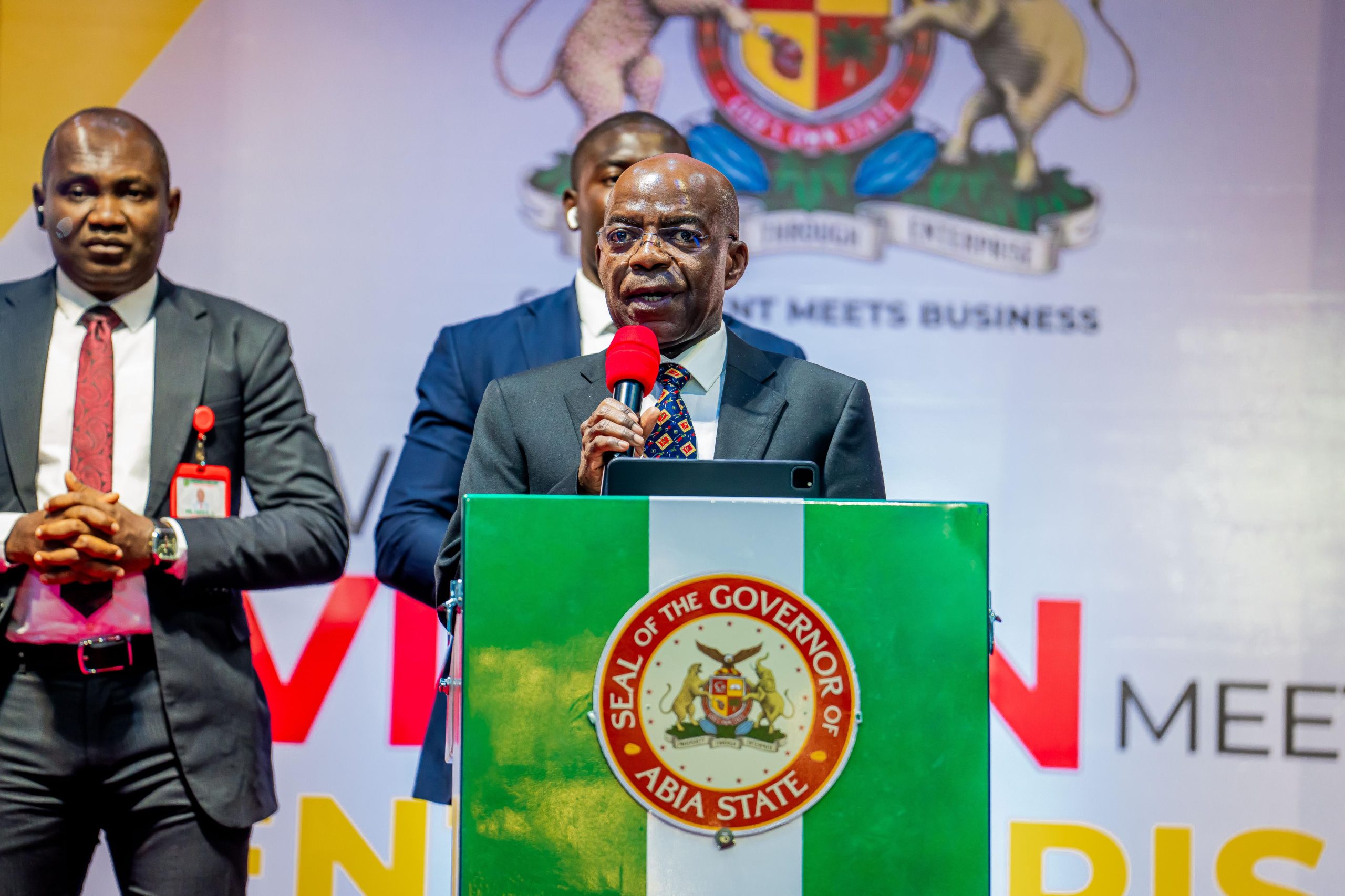
Speaking during the inauguration of the project on March 25, 2026, Gov. Otti, who was visibly elated with the coming of the plant, said it’s one of the most visible symbols of a broader economic recalibration underway in the state.
The governor’s message was clear and deliberate. Economic renewal is not built on rhetoric but on the slow, disciplined reconstruction of systems that allow businesses to thrive.
For decades, Aba’s reputation as the commercial heartbeat of eastern Nigeria was tampered by infrastructural decay, insecurity and capital flight. The new narrative is being reframed by a steady return of investors, drawn not by publicity stunts but measurable improvements in the business climate.
Gov. Otti framed the development as the “fruits of diligent labour”, pointing to reforms initiated since 2023 that prioritised road rehabilitation, urban sanitation, and security restoration. These are not cosmetic changes. Across emerging economies, evidence consistently shows that investor confidence hinges on predictable infrastructure and policy stability.
The governor revealed that countries, such as Vietnam and Bangladesh, offer instructive parallels. Both nations transformed their manufacturing sectors by focusing on export-driven driven industrial clusters, streamlined regulations and sustained infrastructure investment.
“Vietnam, for instance, attracted billions in foreign direct investment by consolidating industrial production zones, reducing fragmentation and achieving economies of scale. It is this same principle that appears to be guiding Abia’s strategy,” he said.
The economies of scale and place
rather than dispersing production across multiple locations, the decision by Kadji Group to concentrate its beverage manufacturing operations in Aba reflects a globally-tested industrial logic. Centralised production reduces fixed costs, strengthens supply chains and improves distribution efficiency.
Otti revealed that he had encouraged the investors to adopt the model, arguing that a single, well integrated production hub could serve national demand more effectively than multiple smaller facilities.
The result is a plant completed in just 10 months, a timeline that underscores both investor urgency and improved administrative coordination. In global manufacturing benchmarks, speed of project execution is often a proxy for regulatory efficiency. Delays increase costs; predictability attracts capital.
At the heart of Abia’s repositioning lies a familiar but critical truth: infrastructure determines economic destiny. The State Government’s commitment to allocate approximately 80 per cent of its budget to capital projects signalled an aggressive attempt to close long standing gaps.
From reconstructed access roads, leading to industrial clusters, to improvements in electricity supply and urban cleanliness, the strategy aligns with what development economists describe as “enabling environment reform”. Without it, industrial policy rarely translates into tangible growth.
In China, the rapid expansion of manufacturing hubs, such as Shenzhen, was driven by heavy upfront investment in transport, energy and logistics networks. Similarly, Ethiopia’s industrial parks strategy in the 2010s relied on government-led infrastructure provision to attract textile manufacturers.
Abia’s approach, though smaller in scale, reflects the same underlying philosophy.
Jobs, migration and the promise of place beyond capital flows and production metrics lies a more immediate concern: livelihoods. Industrial investments of this scale carry the potential to generate direct and indirect employment, particularly for young people who often migrate in search of opportunities.
Otti’s vision is explicit. By creating a fertile environment for enterprise, the state aims to reverse outward migration and retain talent. This ambition resonates across many African economies, where youth unemployment remains a persistent challenge, in spite urban growth.
The presence of a major manufacturing facility also stimulates ancillary industries, from logistics and packaging to retail distribution. Over time, such ecosystems can evolve into self sustaining economic clusters, reinforcing the initial investment.
Yet, as the governor cautioned, infrastructure and investment alone are not sufficient. The sustainability of industrial growth depends on community ownership and protection of assets.
He, therefore, called on residents to safeguard public and private investments, saying that host communities are often the first beneficiaries through employment, corporate social responsibility initiatives and expanded local commerce.
This emphasis reflects lessons from other regions where vandalism, regulatory uncertainty or social unrest have undermined industrial growth. Stability, both physical and social, remains a cornerstone of long term economic success.
A notable element of the address was the reframing of taxation. Rather than presenting taxes as burden, Otti described them as the state’s share of the prosperity it helps to create. This narrative aligns with modern public finance thinking, which links tax compliance to visible public value.
In advanced economies, trust in government spending often correlates with higher tax compliance. For emerging regions like Abia, demonstrating that revenues are transparently reinvested into infrastructure and services could strengthen this social contract.
There is, however, a recognition that the journey is far from complete. The governor acknowledged that while progress is evident, significant work remains. Industrial transformation is rarely linear; it demands sustained policy discipline, investor confidence and civic cooperation over time.
Still, the inauguration of the Ultimum Beverages plant marks a symbolic and practical milestone. It signals that Aba’s long discussed revival is no longer theoretical but increasingly tangible.
For investors scanning Africa’s evolving economic landscape, the message is straightforward. Capital gravitates towards environments where risk is managed, infrastructure is improving and governance signals consistency.
In Osisioma, amid the whirr of new production lines, Abia is making its case that it can offer all three.
And if the early indicators hold, the fruits of diligent labour may yet extend far beyond a single factory floor, reshaping a region once written off into one that others seek to emulate.
#GovOttiIsBuildingTheNewAbia
To God Be The Glory
Ogbonnaya Ikokwu is a journalist and public affairs analyst writing from Umuahia.